Showing posts with label technology. Show all posts

Thursday, October 16, 2014

Rapidly Changing Technology


A couple of blog entries ago,  Thriller Guy purportedly answered a question from blog reader Marc who asked “How do writers stay ahead of technology in today's world, where today's new feature is old news next week.” TG uses the word “purportedly” because rather than answering Marc’s question, TG used it as a basis to wander off into a thicket of other ideas, never really addressing Marc’s excellent question. So Marc, the short answer to your question is: they don’t. Or perhaps a better answer would be: it’s impossible anyway, so you can’t really worry about it.

We could just leave it at that and wrap up the blog for this week, but as TG’s regular readers know he would never miss an opportunity to opine and digress and maybe rant a bit. TG would like to put some words in Marc’s mouth, because what TG thinks the question really is about is both the ongoing search for cool technology to hang a plot on and then the rapid descent of that same bleeding edge technology into the ho-hum commonplace. TG has written about this in an earlier blog about the proliferation of drone books in the last couple of years. The first of the drone books presented the new technology in all its gee-whiz glory, but as time went on, the following novels had to elevate the technology by adding new tech elements and/or more convoluted plots that expanded the possibilities of drones beyond their simplest uses.

TG would like to digress for a moment, as you know how he loves to do, with a short discussion of the rather old-fashioned words “gee whiz.” After using this term in the above paragraph, he decided to look it up and found that it is what is known as a “minced oath.” Which means using innocuous words for those that are considered taboo, in this case substituting them for the oath “Jesus Christ.” Here is a short but interesting article on minced oaths. 

Gee whiz, Thriller Guy, you do love to go on and on, don’t you?

Yes.

Will you please get back on topic and answer Marc’s question?

Sure, but first, digression number two, on the subject of drones: While recently reading an interesting thriller where the main character was a woman scientist who built tiny but deadly robots, (This was an excellent book, but TG can’t remember the title) a character was discussing why ordinary people have what seems like an instinctive fear of drones in all forms. “People see them as insects,” the character said. “And in this case they’re insects with guns.” Nice image, nice writing.

So to get back to Marc’s question, yes, thriller writers are always, well, thrilled to come across some new piece of technology upon which to build a plot and thereby a novel. But the professional thriller writer knows that what is new today is not going to be so by the time a book is written and published. You can hope that your tech discovery remains undiscovered by other thriller writers, but the truth is that there are a lot of guys and gals out there who write these kinds of thrillers and who are always combing the Internet for the next big tech marvel, so don’t depend on your chances of keeping your cool idea a secret. If you found it, so did someone else, and maybe he/she is a faster writer than you are.

There’s a corollary problem here that is also interesting. What do you do about Fidel Castro? His name comes up in thrillers quite often, but the guy is 88 years old and in bad health. It takes a regularly published book 12 to 18 months to go from completed manuscript to bookstore shelves, plenty of time for Fidel to drop dead. The best idea is to just not use him in any way in your thriller. Or, as in a thriller TG is currently reading for review, the author just went ahead and said he was dead. It probably looked like a pretty good bet many months ago when the manuscript was turned in to the publisher, about the time Fidel was in dire health straits. But he beat the odds, and now he’s in this guy’s book as being dead, when he isn’t. Does it make a difference? Not really, but little glitches like that always startle a reader out of the suspension of disbelief that writers want to keep them in. There are plenty of other major historical events that can derail a thriller that is in the production process: the Twin Towers can fall, as can the Berlin Wall. Young Kim can be dethroned in North Korea, and even presidents can be felled by assassins. The best you can do is not worry and soldier on.

Now we’ve come to the place where the Association of Those Who Think They Are Experts in Giving Writing Advice (of which TG is a proud member) insists that we say that you shouldn’t be hanging your novel on a cool piece of technology or fabulous historical find and expect that to carry your book onto the bestseller lists or even the Pretty Good Seller lists. We are obligated to remind you that good books are built on the backs of good characters with interesting multi-layered plots and attention to all the details of good writing. Yes, sure, but we’re talking about thrillers here, not the next great American novel. Here comes the rant…

Thriller readers don’t really give a shit about good writing. You can easily learn this by simply reading, say, ten thrillers that are on the bestseller lists. These should be the cream of the vast thriller crop, and yet it is TG’s experience (also vast) that of those ten, one might be considered to have what is considered excellent writing (that is writing that might be commonplace in a work of what we call literature) seven more will fall into the spectrum of damn good to OK to not very good at all, and two will be just plain bad.

Digression number three: In the ten years or so that TG has been in the professional criticism business, he has seen the quality of writing, in general, rise. Snooty critics will tell you that it has fallen, but they are wrong because snooty critics don’t know anything about genre writing. TG attributes this rise in quality to the old timers who really built the thriller genre and are now aging out and hiring other writers to help them or even take over their writing duties. You’ve got guys like Jim DeFelice and Mark Greaney and a bunch of others who are building on already established series characters and venues, guys who are actually better writers than the originals who invented their brands. There are reasons that they are better writers, but that’s a topic for another blog entry that TG may get around to writing some day.

The point is, Marc, and all you other readers and writers out there who have stuck with TG this far, while TG would love to see every book he reads and reviews be a work of excellent craftsmanship, if not literature, that’s not going to happen. So when TG picks up a new book, he is always on the lookout for a really great, new, inventive high tech, low tech, new or brilliantly refurbished plot concept or single device that will be the linchpin that holds the novel together and gives it power. (If a linchpin can actually power anything.) It doesn’t always happen, in fact it usually doesn’t, but smart writers who find such a device, and the lucky ones who hold it close and are first out of the gate with it, are a rare and blessedly fortunate bunch.

So there’s your answer, Marc: pursue this thriller grail, and if you find it, hold it close and write fast. If you can’t come in first with it, try to come in better than the other guys. But if you worry about it, you’re just going to drive yourself crazy. And writers already have enough to drive themselves crazy without adding anything to the pile.

So TG will remodel the mantra:

Sit down, shut up; get to work. And stop worrying.


Tuesday, September 23, 2014

From 7th Century Irish Monks to Fifty Shades of Grey


Thriller Guy’s sermon, lecture, rant of the day sprang (sprang?) from a remark by one of his readers, and after research -- too much research -- splintered into a number of blogs that began to circle on TG’s computer screen. Eventually, after a journey through 20 or so centuries, we end up home. So buckle your seatbelts and put on your thinking caps, you’re in for a bumpy read.

Blog reader and writer pal Mark sent TG this suggestion in an email.  “I have been wondering about whether mathematicians still write their formulas on chalkboards or greaseboards. I have a scene in my novel with dueling mathematicians and needed to know. Turns out they mostly do it on computers these days, but some old school types still like the smell of chalk dust. Anyway, it begs the question, how do writers stay ahead of technology in today's world, where today's new feature is old news next week. Tell us, oh Thriller Guy, what's a diligent author to do in this golden age of discovery?” For some reason this sent TG’s mind into the world of technology and how these days we usually consider that word in terms of computers, iPhones, stealth airplanes, advanced medical procedures, electric cars, self driving vehicles, etc. etc. Machines, in other words. But TG began thinking of the technology of deep time, i.e. the invention of copper allowing ancient Egyptians the technology to make saws that could cut giant blocks of stone, which could then be piled up into pyramids, and other ancient technologies which were modern and cutting edge for their time. But not necessarily machines or physical objects. Technology that springs directly from the intellect. For example…

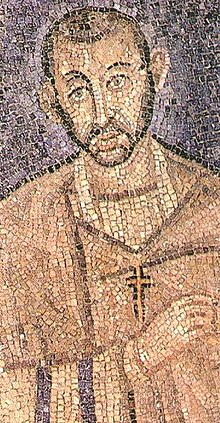
Blog Number One. Around the year 370 A.D. Augustine of Hippo, who was not yet a
St. Augustine
St. Ambrose
Christian nor a saint but a famous philosopher, had gone to see Aurelius Ambrosius, who was later to become a saint himself, Ambrose, in Milan. Ambrose was very famous, and it was the custom to allow people to come into the rooms of the famous and stand and watch them as they went about their business. The rule was you couldn’t speak or in any way interrupt these great minds while they were at work. So there’s Augustine, standing in a small crowd of people, watching Ambrose reading a book. After a few minutes it came as a shocking revelation to Augustine that Ambrose was not only reading his book in complete silence, he wasn’t even moving his lips!  Augustine would write about this at a later date, saying, “Now, as he read, his eyes glanced over the pages and his heart searched out the sense, but his voice and tongue were silent.” What struck TG as amazing was the realization that silent reading was an “invention,” that Ambrose was seeing something he had never seen before and until this time did not exist. Up until then, everyone read out loud. (For a number of reasons that TG will get to.) So silent reading itself was a kind of “technology,” an invention. But before TG could write about this, he needed to do some research to get his dates and other facts correct, which led to…

Blog Number Two: research, and the dangers, pleasures and profits of submerging oneself into the warm, distracting intellectual pools of the Internet and its wonders. TG is intimitaly familiar with this danger, or at least his alter ego Allen Appel is. Appel is, among other things, an historical novelist. (See and buy his Pastmaster time travel series here. You’ll be glad you did.) Historical novelists spend huge swaths of time on the Internet looking stuff up. Imagine the face of a clock in an old movie as the hands circle the clock face indicating hours flying by by as TG starts out to look up a few simple dates and along the way wastes an entire day
Lincoln's boots
on this blog post instead of reading the books he is paid to read or writing the book he has pledged to write. And it is always thus: when writing a novel you stop to look up the size of Lincoln’s boot and surface back to reality  hours later, dazed, but now knowing everything from the invention of shoes to the amazing modern day technology -- there’s that word again -- of the shoemaking industry. (For the record, Lincoln wore a size 14.)


Back to Augustine and Ambrose. Some interesting facts, because there are always interesting facts; who can resist them?

Ambrose: There is a legend that as an infant a swarm of bees settled on his face while he lay in his cradle, leaving behind a drop of honey. His father considered this a sign of his future eloquence and honeyed tongue. For this reason, bees and beehives often appear in the saint's symbology. He is alleged to have founded an institution for virgins in Rome. Because he refused to be drawn into a conflict over which particular church had the right liturgical form, he said, "When I am at Rome, I fast on a Saturday; when I am at Milan, I do not. Follow the custom of the church where you are." Which has come down to us as the saying, “When in Rome, do as the Romans do.”

Augustine. From Wikipedia: “As a youth Augustine lived a hedonistic lifestyle for a time, associating with young men who boasted of their sexual exploits with women and men. They urged the inexperienced boys, like Augustine, to seek experience or to make up stories about their experiences in order to gain acceptance. It was during this period that he uttered his famous prayer, ‘Grant me chastity and continence, but not yet.’ At about the age of 19, Augustine began an affair with a young woman in Carthage. Possibly because his mother wanted him to marry a person of his class, the woman remained his lover for over thirteen years and gave birth to his son Adeodatus who was viewed as extremely intelligent by his contemporaries. In 385, Augustine abandoned his lover in order to prepare himself to marry an heiress.” His conversion to Christianity was prompted by a childlike voice he heard telling him to "take up and read" (Latin: tolle, lege), which he took as a divine command to open the Bible and read the first thing he saw. Which was, “Not in rioting and drunkenness, not in chambering and wantonness, not in strife and envying, but put on the Lord Jesus Christ, and make no provision for the flesh to fulfill the lusts thereof.” So that was the end of Augustine’s life of concubines and lechery. His feast day is August 28, the day on which he died. He is considered the patron saint of brewers, printers, theologians, and sore eyes.

Back to Blog Number One, about technology. When reading about the invention of silent reading, I learned that until the 7th or 8th century all writing -- and by this I mean Latin writing -- there were nospacesbetweenthewords. Think about that. Because books were dictated aloud, the scribes, usually monks, wrote everything down in one long continuous line. (Scripto Continua.) Because when we speak there are no spaces between our words. And it was worse than that, they also didn’t use any punctuation and there was no upper and lower case. But it was the spacing between words thing that led me to…
Blog Number Three: Whereby Thriller Guy continues his rave against those writers who are still putting two spaces between sentences. This practice has often been said to stem from when writers wrote on typewriters, which use what is called a monofaced font. But in reality it goes back centuries before that in rules for typesetters who felt that the extra space between sentences made text more readable. This practice was adhered to until just after World War II when it was abandoned by typesetters, only to be continued by writers using typewriters. Now, in the computer age when spacing is no longer a problem, the only writers who do it are folks who refuse to change, showing that they are old both in years, and old in that they are resistant to change. Thriller Guy has been told that when an editor receives a manuscript where a writer does this, they almost always immediately reject it. So stop it! you idiots, because, as TG has written a number of times, (Blog Number Four) that writers have to perfect their manuscripts in all ways before sending them out. No matter how they may cry out in protest, TG feels that working editors in major publishing houses aren’t looking for great manuscripts to publish, they are looking for ways to reject those manuscripts that are sent to them. And if you show that you’re old fashioned and hard headed, your manuscript is going to get rejected by editors and agents alike. This also extends to those dopes who send TG manuscripts whereby they have decided not to use quotations marks to indicate dialogue, write in second person present tense, or do other foolish stunts because they think it makes them look cool.
It doesn’t.
Which takes me back in full circle to Blog Number One: spacing between words and the invention of silent reading. It turns out that separating the words was an invention of Irish scribes, for a number of reasons. (By doing so they could remember longer passages without having to refer back to the original text so often; because they were often monks sworn to a vow of silence so they couldn’t be muttering to themselves in the library where they were working, and others.) Eventually, the value of silent reading filtered down to the lay classes in a number of interesting ways. You could read books that advocated rebellion and overthrowing the king and not be heard plotting out loud, and finally it allowed and boosted the “circulation and consumption of pornography.” !!!
Thus proving, once again, that everything -- and TG means everything -- always comes back, somehow, to rest in the primal and exciting arms of pornography.
So let this be the lesson: Without spaces between words and those Irish monks who invented the concept, we would have had no Fifty Shades of Grey.
Go, my children, and may the message of Thriller Guy’s words lead you and guide you, forever and amen.