Showing posts with label Tom Clancy. Show all posts

Saturday, January 16, 2016

Better Dead Than Alive

Thriller Guy would like to apologize for being so remiss in posting lately. Most of his blogging energy was used up by Allen Appel over at his memoir blog at http://mylifeinthebigredband.com. That blog is about to go on hiatus, so TG will be back pissing and moaning and bitching about books, authors and the Writing Life again right here.

Thriller Guy was reading a thread about, what else? thrillers on Facebook where a lady,
complaining about how so many big time authors seem to have faded recently, said, “I’ve stopped reading Tom Clancy, he’s just been phoning it in for the last few years.” TG thought this was a tad unjust, seeing as the man has been dead since 2013. And in fact, TG thinks the lady is flat out wrong: Tom Clancy’s book are far better written since he stopped writing them. And TG believes this is true in the majority of cases where a beloved, mega-selling author has brought in hired help to actually write his books for him. Generally, these co-authors or ghosts are better writers than the originals ever were, dead or alive. Full disclosure, TG’s alter ego Allen Appel and several of his friends have ghost-written a number of books, though never for anyone as famous, at least as famous in the fiction world, as Clancy.

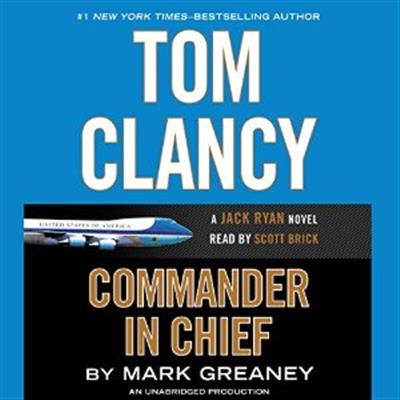
Mark Greaney is the current author of Tom Clancy’s Jack Ryan series and has written, or
co-written, six of Clancy’s novels. Clancy’s first co-author was Larry Bond, who is one of the top military fiction authors in the world today. Other authors who have penned Clancy novels are Grant Blackwood and Peter Telep, both excellent novelists in their own right. These guys are said to make between $40,000 and $70,000 for writing a top author’s books. This is “work for hire,” they generally do not share in royalties.

Greaney has nothing but nice things to say about writing the Clancy series. He started doing it a couple of years before Clancy died, so he had actual contact with the man who he was writing as. TG spoke with Greaney and asked him if he was consciously trying to write in Clancy’s style and he said not really, but that writing in Clancy’s “world” made his work different than when he wrote his own books.

Greaney writes a series known as the Gray Man novels. TG reviewed the most recent book
in the series, number five, Back Blast, and thought it was terrific. Greany can write Clancy better than Clancy could write Clancy, but he really comes into his own when he, well, comes into his own. Greaney’s hero, Court Gentry, The Gray Man, is back in the US trying to find out why the CIA has a standing kill order out on him. To get answers he has to out-think and out-gun the scores of folks from various agencies who are trying to kill him. Gentry is a far more interesting protagonist than Clancy’s Jack Ryan or Jack Ryan’s son, who has taken over the action role in the series. TG recommends readers of these types of thrillers start with Greaney’s latest and if you like it, go back and read the entire series. As far as his Clancy-inspired books go, if you liked them when they were written by Clancy, don’t shy away from them now. You’ve still got many of the old Clancy characters, the plots are huge and Greaney does a great job of hunting down and inserting all the tech and military details that Clancy pretty much trademarked while he was writing the books.


So, to that lady who complained that Tom was phoning them in, give him another chance. He may be dead, but his writing is better than ever.

Tuesday, September 2, 2014

To Err is Human?


Thriller Guy is surprised at his usually perspicacious readers. Last week’s entry had a serious mistake, and only Thriller Guy reader Bill Parke caught it, or at least he was the only one kind enough to send TG a note. Here’s his email, beginning with a quote from TG’s blog entry:

"And one last low-tech tool solving a high-tech problem. When you shoot someone, it’s always smart to clean up your brass before making your getaway: (from the book)  "Behind them, Isfahan climbed out of the sedan with a long device in his hands that looked something like a metal Broom. It was a NailHawg magnetic nail sweeper, used by roofers for collecting loose roofing nails in grass. Quickly and calmly he rolled the device back and forth in the alley where his two colleagues had been standing, and he picked up eleven spent shell casings from their weapons.”"

Bill Parke: This is a good way to see if your readers are paying attention, but you probably it planned that way. If not: Maybe the Nail-Hawg is magico-nuclear (or is it nucleo-magic?), but my spent brass is brass, non-ferrous. When shooting, I always go out in the yard with a 5 gallon bucket because I gotta pick 'em all up by hand. The ones I miss become launch vehicles when I mow the grass.”

When TG read the bit in Mark Greaney’s novel, Tom Clancy: Support and Defend, he realized it would fit nicely into his series of ongoing entries offering up cool techno stuff and ideas for his fellow thriller writers to admire and take advantage of. At the time, TG heard the sound of a faint bell ringing in his subconscious, an alarm that he sometimes gets when something he reads doesn’t “ring true,” but feeling lazy at the time, he decided to just let it go through without checking on it. (Small voice in back of brain: brass is made up of zinc and copper, are either of those magnetic? I don’t think so, but maybe they put some iron in there somewhere in the shell casings.) In any case, the electromagnetic NailHawg is bullshit, but here’s a nifty little device that actually does the job, though it's not nearly cool enough to put into a cutting edge thriller.

All of this begs the question: How did this slip through editing and make it onto the finished pages of the book? Thriller Guy, well, his alter ego Allen Appel, has published many books. (Go to this site to purchase all of his novels on Kindle. You’ll be glad you did.) This was back in the day when the copy editing was done by a band of doughty (when’s the last time you saw that word?) women -- please spare TG the sexist accusations, they were all women as far as TG knows -- who questioned everything. Nothing escaped their intelligent, eagle eyes. TG would sit and cringe as he read their polite but scathing edits, as they eviscerated every page and coolly pointed out his ridiculous mistakes. Every writer TG knows felt the same way; experienced the same shame. And then legacy publishing decided one of the smart moves they could make to raise their profit margins was to fire all the copy editors. This dumbass idea came right after they cut all their author advances by two-thirds. So now books hit the stands with howlers studded into the text like raisins in an oatmeal cookie. Sigh. TG understands he’s geezing here, but does anyone actually give a shit anymore? Evidently not.

One also wonders if Tom Clancy had been overseeing this novel if he would have spotted this mistake. As noted in the earlier blog, TG liked this book. Greaney is undoubtedly a better writer than old Tom ever was. TG has written before (or has he?) that one of the greatest assets that Clancy possessed was that the military loved him and would go to great lengths to accommodate his requests for info. They loved to fill him in on cool stuff that was semi-secret, and allowed him to play with many of their toys: Hey, Tom, wanna drive a tank? Fire a missile? No problemo. Maybe Greaney enjoys this same advantage, along with all the other guys who are now penning the individual volumes in the Clancy empire as Putnam and the other fat cat publishers lay back and roll around in all the dough the guy still brings in.

TG has a suggestion for these fat cats. How about spending a few bucks on some real, old-fashioned editing. Before the Clancy reputation for accuracy migrates down in the dirt with all those pesky shell casings.


Thursday, August 21, 2014

Cool Info For Hot Writers


OK, here’s the thing. Thriller Guy is not going to dump ice water over his own head. TG sends out plenty of checks to various Good Causes and he doesn’t need a video gimmick to encourage him. But the rest of you, feel free to dump away, just stop cluttering up TG’s Facebook page with the videos.

TG’s vacation was good, a few days at the beach, a few days having fun with Mrs. Thriller Guy. Then TG came back to a house with a flooded basement and other problems, but because TG has a cheerful heart he just shrugs off these challenges and climbs back into harness. Today’s blog focuses on some more cutting edge technological advances that savvy thriller writers can use to arm their heroes and advance their plots. Gone are the bad old days when a conscientious writer had to painfully work his way through fifty separate steps to locate a bad guy just to get the action moving. So is the new technology a boon or boondoggle for mystery/spy/thriller writers? Here, in the Guardian, Charles Cumming (an excellent spy novelist, TG says read his books) gives us his opinion, which is, essentially, that LeCarre could have never written The Spy Who Came in From the Cold with today’s available gadgetry. Hmmm, probably, but he would have written something else just as good, which he continues to do to this day. Read the piece and send TG your comments. 
Richard Burton in The Spy Who Came in From the Cold.


The age of fingerprinting was seminal in the history of criminality and in the plotting of mystery novels. The advances in this technology, in particular biometric devices that electronically read fingerprints, has seemingly made some locks pick-proof. But have they? Here are a couple of sites that teach you and your spy/agent/detective/hero how to overcome these sophisticated locks. The following website article will teach you how to defeat these devices with the use of the decidedly low tech Gummy Bear. And if you’re unable to find a bag of these tasty Swedish candies, here’s a site that will show you how to do it with Play-do, Silly Putty,  Elmer's Reusable Adhesive Tac 'N Stik, Rose Art Modeling Clay, or Crayola Model Magic Soft, Spongy Modeling Material.
  
Every writer knows by now the dangers inherent in allowing one’s hero to run around carrying a powered-up cell phone, or any cell phone, even if it’s turned off. And, conversely, how that same cell phone is an incredibly valuable tool in the hands of even the lowest tech investigator. In the same Guardian article, Cumming points out that if you want to know where someone has been recently, simply snatch his or her iPhone and try the following: press "Settings", "Privacy", "Location services", "System services" then "Frequent locations." Try it on your own iPhone and see how it works.

In an article TG was reading about the hacker, Edward Snowden, Snowden suggests that to keep from allowing your or anyone else’s cell phone from broadcasting one’s location, you can simply put it in a refrigerator or even in a metal cocktail shaker. Make sure to remove the phone before making your next martini.

If you’re including a team of Navy SEALS in your next plot (and who isn’t?) you can have
them ride beneath the waves in style with some new, really cool underwater submersibles. 

And if you want your hero to find out what is being said inside a room where you haven’t implanted a listening device, scientists have figured out a way to film an object in the room -- in this case an empty potato chip bag -- and reconstruct sounds that have occurred in the room, even audible speech. Check out this amazing article and video about these experiments.

Then there’s this article whereby scientists where able to figure out something, TG is not exactly sure what, which could be key to a novel-twisting plot point. Maybe you can figure it out and explain it to Thriller Guy. 
TG is reading and enjoying the latest Tom Clancy novel, Support and Defend, written by
Mark Greaney, Clancy having been dead for some years now. This is a continuation of The Campus series. TG was always a Clancy fan, although sometimes very reluctantly. He wasn’t the greatest writer, but then who is? and who needs to be a great writer to pen a perfectly good thriller anyway. What Clancy had, was access. Every branch of the military loved the guy and would sit patiently with him for days and weeks divulging tech info on all their cool weapons systems, even the secret ones, which he would then slot into his novels. So readers were always pretty much guarenteed tidbits and factoids that would astound and amaze. Greaney continues this procedure, and here are a few items that TG is passing along from Support and Defend. TG gives high marks to this book and the series.

In one scene he has his hero, Dominic Caruso, inside a house that is protected by a motion detector: “Dom walked slowly now, his entire body moved less than three inches a second, meaning each step through the house took ten times longer than normal. Off the shelf, motion detectors were typically set to notice movement that tracked faster than three inches a second, so Dom and his teammates at The Campus had spent many silly yet laborious hours of training to defeat motion sensors by walking through the hallways like wind-up toys whose springs had sprung, giving them little energy for movement.”

And more cellphone stuff: “He then carefully opened the back of the phone with a small screwdriver and photographed the number on the SIM card. Dom knew, with the right equipment, the subscriber identity module number could be used to track the phone or trace its usage.” Thriller Guy isn’t actually sure how to go about this tracking, but he is sure there’s a site somewhere on the Internet that gives instructions on how to do so.

And one last low-tech tool solving a high-tech problem. When you shoot someone, it’s always smart to clean up your brass before making your getaway: "Behind them, Isfahan climbed out of the sedan with a long device in his hands that looked something like a metal Broom. It was a NailHawg magnetic nail sweeper, used by roofers for collecting loose roofing nails in grass. Quickly and calmly he rolled the device back and forth in the alley where his two colleagues had been standing, and he picked up eleven spent shell casings from their weapons.”

So there you go, thriller writers, say thank you.

You’re welcome.

Tuesday, October 8, 2013

Michael Crichton Reboot


Are posthumous works a road to legacy or simply a belated gift for hungry fans?

Tom Clancy's recent death prompts Thriller Guy to wonder how long it will be before his publisher starts cranking out all the unpublished novels that are possibly sitting in Tom's desk drawer, how long before authors will be hired to write new novels under Tom's name. Then there's that treasure trove of ideas scrawled on the back of cocktail napkins that they're bound to discover when all the aforementioned books dry up. Here with thoughts on this phenomena, Guest Blogger Frank Zubek ponders this thorny question.

Frank is a Cleveland-based writer and is TG's eyes and ears onto the world of popular media, keeping him updated on what is going on outside TG's basement bunker. To find access to Franks writing, check out his bio information at the end of this post. Thanks, Frank.

A hopeful writer hammers out a handful of novels and despite the odds, gets published. Over time, if they get very lucky, they become a “Name” and enjoy the good life of fame and all of its fortunes and spoils. Then, inevitably, as what happens to us all, they pass on, leaving behind a number of works that, depending on their popularity, continue to be published.

Decades later, if the works continue to prove popular, the work continues to see print and becomes a classic, outliving the author ten fold. Sometimes, a forgotten manuscript is found and with the help of a ghostwriter, gets published. A final work by the author that may have been lost to history finds new life. Countless examples can be found here.

Or, thanks to e-books, forgotten books from several decades ago can find new readers today. For example, if you have enjoyed the work of author Michael Crichton, you’ll be happy to know that eight novels he wrote in the sixties and seventies have been re-released.

These were written under the name John Lange and the titles are: Odds On, Scratch One, Easy Go, Zero Cool, The Venom Business, Drug of Choice, Grave Descend and Binary. They were released as e-books in July, through Open Road Media, and will be released as paperbacks starting October 29 through Hard Case Crime. The links to these books can be found on his official web page.


Now while this may be a lucky break for long-time Crichton fans, I find myself wondering if this is what he wanted?

Once he became a successful writer, he must have known that re-releasing the eight out-of-print books would be a happy discovery for his fans. But what if he figured that these eight books, having served their purpose back in the day -- helping him pay some bills while he studied to be a doctor -- should remain in the past? While they could no doubt still be found on a few dusty shelves of a used bookstore, the more recent works (Jurassic Park, Disclosure, Timeline and Prey), were written by a more skilled and practiced hand.
 

Granted, I have no knowledge of Crichton’s actual wishes for his intellectual properties, but is this truly the preservation of a legacy?  In fact, the market is ripe for additional work from a number of authors. The problem is, how do you continue the brand without the writer? The solution is to marry up a writer’s work with another writer who agrees to carry on the legacy beyond any known original work and this practice has been going on for decades.

V.C. Andrews continues to be a popular author of note despite the fact she died of cancer in 1986. Frank Herbert’s Dune series, which had originally been just six novels (the last book, Chapterhouse, Dune, was published in 1985), has grown into a successful franchise starting in 1999, thanks to his son, Brian, and noted sci-fi writer, Kevin J. Anderson.

While I have no problem keeping a popular brand in print after the author is gone (I myself buy some of these 
kinds of books), is it morally right to continue creating new work from the original stock? Does the success of a growing brand dilute the power of the original work? Arguably, the estate should be allowed to benefit as long as there is a market for the brand. And while most every writer would love to be remembered for at least a generation or two beyond his last breath, just how much is owed to the fan? If not for the fans and their devotion, where would the writer be? A book is published and the fan buys a copy and reads it. The unspoken contract has been fulfilled. Hasn’t it?

 And yet there is this popular business of keeping the name going through posthumous branding. Is it possible to know when to stop? And even once the inevitable happens and the brand sputters to a stop, there are several cases where, after some time has passed, it can be rebooted for a new generation of readers.


How much is enough? After all, as long as each generation of fans are willing to read and experience new material, who’s to say when the proper stopping point might be? As a brand builds its foundation, the long-time readers reap the benefits just as much -- if not more -- than the new readers do.

For example, the Ian Fleming estate continues to allow new authors the freedom to write new books, which not only work to feed the popularity of the ongoing films but also encourages new fans to explore the original Fleming classics.

At the end of the day, it comes down to this. Should a book series that ran out of time and lies buried in the past…remain there? Willing readers and commercial freedom can argue that point. Should a number of new books by different authors keep the name in the public eye until the readers move onto other names and brands? Ultimately, these are all questions that maybe one day, only the endless footsteps of time can answer.


If you wish to explore this subject further, here is a near complete overview of the most popular book series


Frank Zubek, a writer based in Ohio, has a number of short stories and novellas available on kindle or in audio format.


Frank Zubek
Cell  440-364-0628

Friday, October 4, 2013

Reaper Report: Tom Clancy: Dead


As readers of this blog know, Thriller Guy is always happy to speak ill of the dead, so, he would like to announce that it is well known in the book world that Tom Clancy was, personally, an insufferable ass. Before you chastise TG for being cruel, be aware that many in the Publishing Bizz also think that TG himself is an insufferable ass. And TG would like to state right up front that Clancy’s early books were favorites and that he has reviewed the books over the years and has always admired the work, even if the middle years were sort of boring. But the guy could be a real mean, arrogant bastard. Many are the stories, and if one goes back into the thriller Guy archives one would find this one by my friend Kathleen Ewing but TG will not report any of the better ones here because the people involved are all afraid that somehow this will anger the book gods and go against them the next time they’re trying to peddle a book or manuscript. Today’s Washington Post is the first to touch on this touchy subject with a piece about an interview Peter Carlson did with Clancy years ago. If anyone would like to chime in with one of these stories TG would be glad to put it on the blog.

Clancy lived just down the road from TG. When his first book, The Hunt For Red October came out and was beginning it’s phenomenal rise up the bestseller lists, TG went to the local bookstore in our small community. TG can’t remember what this bookstore was, but it was a small version of one of the big chains. It was always an odd store, with books piled haphazardly on the floor and scattered carelessly across the shelves. The manager and seemingly only employee was a gray-haired frazzled woman who always looked like she was in way over her head. On the day of TG’s visit, he noticed a pile of Clancy’s Red October book on top of which the woman had written in ballpoint pen on a piece of shirt cardboard: Local Author. I commented on the book and sign and she said that since she had put up the sign Clancy had become a bestselling author. TG asked a couple of questions, but the woman firmly believed that the sign was the single cause of his success. TG went home and wrote a little note to Clancy to tell him this mildly amusing story and sent it off. Of course he never wrote back.

But TG has a more important reason for bringing up Clancy, besides the fact that he enjoys speaking ill of the dead and saying things that everyone else is too polite and afraid to say. Here’s a lesson in the business of writing.

The story of Clancy selling his book to the Naval Instituted Press has been told over and over again for years. How they gave him $5,000 for what was the first novel they had ever published, having done nothing but non-fiction before that. How Ronald Reagan plugged it and the rest was history. So skip ahead to the day Clancy wanted to dump the N.I.P. for a Big Time Publisher, Putnam, in this case, where he could make even more millions than he was currently making. Turns out that the first contract he signed with N.I.P. – he had no agent – gave all the rights to all his characters to them. In other words, they, not Clancy, owned the rights to his series character, Jack Ryan. Clancy had to go to the mat with the N. I. P. and in the end had to pay them a bundle -- TG heard at the time it was a million dollars -- to get the rights back. Think this sort of thing is rare? When TG signed his first contract for the first book in the Pastmaster series (available for Kindle here) his brand new agent pointed out that the same clause was in his contract. TG only wishes he could go on to say that after the Pastmaster book and a couple of more came out that he had to pay a million bucks to get his character, Alex Balfour, back. No such luck. TG’s agent, the Nedster, Xed out that pesky clause and made sure it never crept back into the contracts of the many books that were to follow.

Oh, did TG remind everyone already that all of these wonderful books can be found on Kindle here?