Showing posts with label Allen Appel. Show all posts

Thursday, October 2, 2014

TK


Thriller Guy is turning the blog over to his alter ego, Allen Appel, for this installment. Don’t screw it up, Appel! TG wants this blog back in the same shape it was in when he handed it over.

Geez, relax, TG, it’s going to be OK. Today’s subject under discussion is Mark Twain and the wonders and dangers of research. Why? I'll get to that in a moment. Well, as always, it will probably take longer than a moment.

As some of you may know, I’ve been working on a new entry in my series of novels featuring Alex Balfour, a time traveling history professor who has drifted back in time to a number of interesting historical periods, among them the Russian Revolution, the American Civil War, the Old West and WWII. In his adventures out West in Twice Upon a Time, he befriends Mark Twain and the two of them
have a exciting time floating down the Mississippi River on a raft with a pair of American Indians who are escaping back to their homelands. Also on the raft are two homicidal maniacs. Blood, justice and redemption flow like the swift current of the river.

Aside:  I’m often asked, as are all writers, “Where do you get your ideas?” Stephan King has a mildly amusing response on the order of “from the mom and pop writing store down on the corner,” but the book with Twain as a character, Twice Upon a Time, came about because of a comment from a film producer. My first book, Time After Time received very nice reviews when it first came out, especially in the New York Times Book Review ((January 26, 1986). What happens when this occurs -- a good Times review -- you get a lot of interest from Hollywood. My agent was flooded with requests from filmmakers for a copy of the book, which he dutifully sent out. Unfortunately, no one bought it. Why? Not because they didn’t like it, they did, but because it was set in Russia during the days of the revolution. Too expensive to produce, they all said, adding: tell Mr. Appel to set his next book in the United States. OK, I could do that. So I settled on opening the next one, Twice Upon a Time, at the great Philadelphia Exposition of 1876 and ending it high on hill overlooking the final battle known as Custer’s Last Stand. I figured you couldn’t get more American than that. The Exposition might cause a few difficulties as far as re-creation goes, but surely all the western scenery was still there for the taking. The upshot of the story is while Twice Upon a Time garnered nice reviews, no one bought the film rights for this one either. So much for doing what a film producer advises a writer to do.

Using Twain as the “buddy” in Twice Upon a Time did not immediately spring to mind when I was blocking out the book in outline. It was only when reading about the exposition did I find that both Twain and Custer attended the fair. Did they meet? Who knows? I found no record that they did, but it wasn’t important to my story. The idea was planted and would soon grow into an entire novel. These two famous men might not have known each other, but they certainly met my time traveling hero, Alex Balfour.

Aside: Readers who frequent the Thriller Guy blog know how important research is to TG and to me, and any other genre of historical novelist. TG has warned of the dangers of spending too much time wandering the labyrinthine byways of the Internet, but do I take TG’s advice? Not always. So after writing the above paragraph about Custer and Twain meeting, I thought I would look around and see if they ever did meet. It seems the answer is no, but along the way I discovered a fascinating  historical fact that is more than enough to spark an entire novel in some fertile writer’s mind. I am resisting the pull of this factoid, as I have my own book that must be written. Here it is.

In a Wikipedia  article about Manor House, a stately home in Soho, London, which was built in 1678…    The White House brothel. In 1776 the house, known then as The White House, was bought by Thomas Hopper, who, between 1778 and 1801 styled it as an hotel although all contemporary accounts point to its real business being as a high-class magical brothel. The White House is described as being garishly decorated and had lavish themed rooms including the "Gold Room", "Silver Room" and "Bronze Room", a "Painted Chamber", "Grotto", "Coal Hole" and most famously the "Skeleton Room" which contained a mechanized human skeleton designed to scare the staff and patrons alike. Henry Mayhew called the White House a "notorious place of ill-fame" and wrote: “Some of the apartments, it is said, were furnished in a style of costly luxury; while others were fitted up with springs, traps, and other contrivances, so as to present no appearance other than that of an ordinary room, until the machinery was set in motion. In one room, into which some wretched girl might be introduced, on her drawing a curtain as she would be desired, a skeleton, grinning horribly, was precipitated forward, and caught the terrified creature in his, to all appearance, bony arms. In another chamber the lights grew dim, and then seemed gradually to go out. In a little time some candles, apparently self-ignited, revealed to a horror stricken woman, a black coffin, on the lid of which might be seen, in brass letters, ANNE, or whatever name it had been ascertained the poor wretch was known by. A sofa, in another part of the mansion was made to descend into some place of utter darkness; or, it was alleged, into a room in which was a store of soot or ashes.”

This scenes this paragraph calls to mind just scream to be written into a BBC series. If anyone picks up on this idea, Thriller Guy gets a cut.

What was I talking about? O, yeah, Mark Twain. Because Twain is a character in the book I’m now working on, whenever I see his name mentioned I read what the reference is to. In this case, it was a small notice saying that the only footage ever made of Twain, a small piece a few minutes long, shot by Thomas Edison, had been reworked and cleaned up using modern techniques so the movement was more natural. (Because something is preventing me to imbed the video,) That piece of film can be found here, and I recommend looking at it. I had seen the original footage when I was working on Twice Upon a Time, many years ago, but it was difficult to make out because of the deterioration of the film stock and the herky-jerky movement. While there are still problems, the new version is vastly improved, and I find, fascinating. It’s not often that a historical novelist comes across such a valuable artifact. While the details would probably not interest most people, I was fascinated to note things like how Twain’s famous white suit, which you always see in photographs as being pristine, is beyond rumpled, and Twain looks kind of seedy in it. His hair is likewise not the glowing corona that it appears in official photos, but sort of like the suit, kind of rumpled. Even though the film was made in the year before Twain died, he seems full of life and an easy vigor, which was a surprise. In the early frames Twain walks around the corner of his house, Stormfield, and past the camera and then, magically, appears coming around the same corner and walks towards the camera once again. Why? Then he sits at a table having tea with his daughters Clara and Jean, who laugh at something Twain is saying to them. Jean spends some time putting on her hat and securing it with a hat pin (who sees that in this day and age?) and then they all get up and walk off screen. As I said, invaluable to a writer who is writing about Twain.

It is also interesting to note that we have no recordings of Twain’s voice. Edison made some, but they were on wax cylinders and melted during a fire, and a cylinder made by Giani Bettini (a pioneer audiophile)  was destroyed in WWII. The closest thing we have is a recording from Twain’s famous frog story being read by a noted actor and accomplished mimic of the time William Gillette, who grew up next door to Twain and knew him well. Here is that recording.  He sounds like Hal Holbrook, who must have referenced it when putting together his one act play about Twain.

The point here? Beware of research; it is a wonderful thing for a writer, but a great thief of time. And also a wonderful excuse, as in: “I’ll start my book once I feel I really know my material.” It’s nice to have that confidence and I applaud writers who can work to achieve this mastery and then start right in on their book, but I, and Thriller Guy, think that what you need to do is jump right in on the writing and do the research as you go, or after you finish a draft. Journalists have a wonderful device, the letters TK, which when inserted in a work in progress mean that more information will be added later, TK = “to come.” Use this device whenever you’re really rolling and don’t want to stop and break the flow. You can always look something up and put it in later, but you can’t always regain momentum when you break your train of thought. 

Saturday, September 20, 2014

Bastard Stepchild


Yo. Thriller Guy has a question: Why is the novella the bastard stepchild of the writing world? What is it about this not-so-short, not-too long, form that makes it so unattractive that even TG, or rather his alter ego Allen Appel, hardly ever buys or reads them? TG realizes that this is a question that approximately two or at the most three of his readers will find the slightest bit interesting, but that’s the thing about a blog, since you’re doing it for free you get to choose the subject.

Every once in a while you’ll see an article or blog post that announces that the novella isn’t dead, or that it’s making a comeback, and then in another couple of years there will be another article saying the same thing, which means that the form is pretty much dead if they have to keep announcing its resuscitation every couple of years.

TG used to think, and it was probably true, that the uncomfortable length made it difficult to market for traditional publishers. You know, the guys who printed stuff out in “books” and sold them in emporiums cleverly named “bookstores.” Let’s get technical, then TG will get back to ranting about something or other in a minute.

All professional writers who are working on a fiction project always know how many words they are “up to” at the end of every working day. Those that tell you they never pay attention to word count are lying sacks of shit posers who will also tell you how much fun they had cranking out their 2,000 words every day, whether they feel like it or not. TG has written many times -- probably far too many times -- about how difficult it is to be a professional novelist. (Note that no one ever describes themselves as a “professional novella-ist.”) So he will skip that whine, and point out that since there’s no everyday payoff for a written work that can take, usually, around a year to produce, novelists have to find things that are positive enough to keep them coming back to the desk every day. Counting words is one of the major benchmarks. So if you got in 500 words for the day, that’s ok, at least you’re hacking away at it; 1,000 is damn good; 2,000 is a remarkable day, one that leads you straight to a largish glass of whatever alcoholic beverage you use to congratulate yourself. As Constant Readers of this blog know, that’s gin for TG, but everyone has their own comfort drink.

So, while there are a number of differing opinions on what constitutes a short story, novella or novel, we’ll just use the Science Fiction and Fantasy writers of America’s word length for each category:

Short Story --- under 7,500 words; Novella --- 17,500 to 40,000 words; novel --- over 40,000 words. In general, a mystery novel is usually 60,000 to 80,000 words, a thriller is 100,000 words. The SF&F folks also have a category, Novelette, that takes up the 7,500 to 17,500 category, but that’s a no-man’s category in TG’s estimation. Besides, what we’re talking about in particular is the novella, which usually comes in at 60 to 120 pages when in printed form. And how does a novella differ from a novel? Besides the obvious answer, being shorter, a novella is usually about one character and there are no subplots and fewer conflicts. Thriller Guy is sure he’ll get some arguments, but here’s a list of some excellent books that are considered novellas by most, though TG thinks some of them are really short novels.

 A Clockwork Orange, Anthony Burgess; Coraline, Neil Gaiman; Heart of Darkness,  Joseph Conrad; I Am Legend, Richard Matheson; Legends of the Fall, Jim Harrison; The Mist, Stephen King; The Snow Goose, Paul Gallico; The Strange Case of Dr Jekyll and Mr Hyde, Robert Louis Stevenson; The Tenth Man, Graham Greene; The War of the Worlds, H.G. Wells; The Old Man and the Sea, Ernest Hemingway; Do Androids Dream of Electric Sheep? Philip K. Dick; The Postman Always Rings Twice, James M. Cain; Of Mice and Men, John Steinbeck

If you haven’t read all of these, shame on you; hop over to Amazon or somewhere and download them or order them used or whatever. Wait a minute, why did TG even start in on this topic? Oh, yeah, he was going to expound on his own experience with the novella form.


The Christmas Chicken was written first and came from an idea hatched with writer pal
Larryabout a little Victorian blind boy who asks Santa for a dog and ends up with a chicken, though, being blind, he doesn’t know the difference. Hilarity ensues. (Really) It started out as a short story, but I am at a total loss when writing in that form; it kind of got away from me and, like Topsy, just growed. (Are we allowed to say that these days?) It got longer and longer and eventually ended up at 20,336 words, around 43 pages and in solid novella territory. Sometime later, while sitting on the porch with a glass of gin, I decided that as a challenge to myself, I would write another story featuring a chicken. I have no idea why I decided to do this, it was probably the gin talking.

At the time I was reading a very cool book by another pal, Peter Cannon, who is a Lovecraft scholar who had written a pastiche called Forever Azathoth, which is very funny. If you’re into Lovecraft on any level I recommend it highly. So I had Lovecraft on my mind, and thus was born The Flock. It’s about a man known simply as The Hunter who sets off into the dark
woods to undertake a life-threatening mission. What he finds in the strange community he arrives at is, well, fairly disturbing. It’s not written to be funny. It came in at 12,500 words, around 26 pages. Not quite in official novella territory but certainly not a short story.

By this time I felt like I needed one more
chicken story, so I decided to write one that was in no one else’s style, just my own. This is a modern tale, a thriller that centers around a chicken: The Maltese Chicken, titled to honor the falcon but not as a joke. The chicken actually comes from the Isle of Malta. It ended up being 36 pages, 17,232 words. A solid novella. By then I was pretty much through with writing about chickens. But I was happy with the three stories and happy to see I could write something besides novels and blog entries. So I put the three stories up on Amazon and charged $.99 for them. I would have simply put them up for free, but Amazon doesn’t like that. They’ve been up for several years and I haven’t sold a single copy of any of them. Well, maybe a couple of copies of The Christmas Chicken. My novels continue to sell, slowly, true, at least compared to Hugh Howey and J. Konrath, but it’s clear if a person buys the first in the Alex Balfour time travel series that person goes on to buy the next four as well. So I know people like my stuff. Occasionally I sell a copy of my novel, Abraham Lincoln: Detective, which I figure has probably been bought by one of my time travel readers who has finished the series. But never the novellas.

So what’s the deal? Why don’t people buy novellas? Or maybe the better question is why don’t people buy my novellas? Huh?

Yeah, you. I’m talkin’ to you. Check them out.


Thursday, June 26, 2014

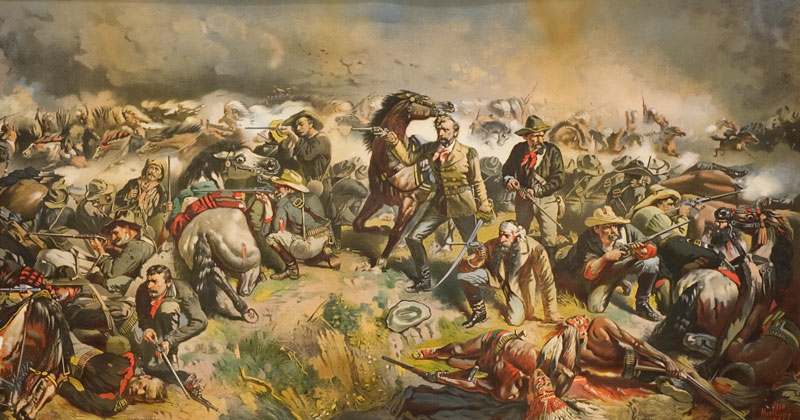
Custer's Last Stand: Twice Upon a Time


Thriller Guy has been given a few days off. He’s working on his latest rant. Meanwhile, Allen Appel noticed that yesterday was the anniversary of Custer’s Last Stand, now known as The Battle of the Little Bighorn. (And known by the Lakota tribes as Lakota Victory Day.) Actually, although Custer was killed on the 25th the battle with the rest of his command took place on the 26th as well. I have written elsewhere on this blog about doing the research for the Custer book, Twice Upon a Time. Besides Custer, I got to read about many other fascinating characters (including Mark Twain) and events of the period. But I aimed the entire book at that last battle from the very beginning. My trip out west to the battle site remains one of my most chilling experiences. Wikipedia has an excellent article on the battle and the Evan Connell book, Son of the Morning Star remains a riveting read.

Here is a section from the final pages of Twice Upon a Time. Readers who wish to learn how Alex Balfour arrived in the Black Hills at the battle can read the book, available here.  

             Custer. Buckskin pants with long fringe, blue-gray shirt now dusted a dull dirty yellow. Hair cut short, his ragged whiskered face flushed, broad white hat pinned up on the right side to allow him to sight his rifle while he rode. Custer saw him, wheeled his horse around, and rode toward him. He reined to a stop and pointed at his stirrup. Alex stuck a Nike in the stirrup and swung up behind the saddle. They rode back the way Alex had come, over the ridge and down onto the far side where there were no Indians, no soldiers, no dust, only an odd, almost unworldly, quiet. Custer pushed him off onto the ground.
             "Get away!" Custer yelled. "Run! You've got a chance if you run!" His horse danced around Alex.
             "Call it off," Alex shouted. "It's not too late."
             "You're the writer," Custer said, distracted for a moment. The horse would not be calmed. Its eyes were wild. Custer wrestled with the reins until the animal was pointed back at Alex. "From back at the exposition. Did you steal my Indians?" Alex just stared at him. "No matter. Too late now." Custer stood up in the stirrups and looked back up the hill. "Tell the world what we did here, writer. Tell them about Custer and his brave men."
 "You can get away," Alex shouted. "If you run you can escape, at least some of you will get away. If you stay you'll die. You'll all die."
             Custer's horse reared and pawed at the sky, twisting as he came down. Custer laughed, his eyes seemed as blue and as bright as the sky. "Yes!" he shouted as he reined the horse around. "Yes!" He turned in the saddle and raised his hand to Alex. "Glorious, isn't it'?" He laughed again and raked the horse with his spurs and galloped away, back up the hill, to his men. Alex watched him disappear, trying to decide if he should follow. And then he saw the Indian.
             The Indian sat on his horse on the brow of the hill, watching.
             Alex held his breath as the Indian made his decision and kicked his horse into motion.
             Alex ran.


Thursday, May 15, 2014

Incredibly Interesting Interview


Thriller Guy has been working for a long time, well, working is not the right word, on a book about how to write a novel. Will he ever get around to settling down and actually putting it all together? Probably not. But bits and pieces of it crop up here in this blog on occasion. In fact quite often. In the course of this noodling, he has been collecting quotes about writing from various writers. From now on, TG will start, or end, these entries with a few of these quotes. He’s not going to comment on them (usually) or expand them, just toss them out there. Good! you say, finally something that he doesn’t have to express an opinion on! I feel your pain. It’s not easy being Thriller Guy.

*
John Updike worked mornings, preferring to "put the creative project first," as he put it. Of his discipline, he said, "I've never believed that one should wait until one is inspired because I think that the pleasures of not writing are so great that if you ever start indulging them you will never write again."
*
Thriller Guy has recently been spending time looking over Allen Appel’s shoulder as he labors away on his latest manuscript. Watching paint dry, grass grow, etc. comes to mind when thinking about how dull this is. The image of a solo writer bent over a computer keyboard has never been particularly compelling, as the failure of many computer-themed thriller movies have shown. TG has been observing this professional novelist-at-work, looking for writing tips ‘n tricks to pass along to his readers. Appel is presently working on a short novel set in the early days of the automobile industry, though it has less to do with building cars than it does with sex and murder. Because watching is so incredibly boring, TG has decided to simply interview Appel in an attempt to cut straight to anything useful he has to offer TG’s readers.

TG: Why should my readers, or anyone else for that matter, look to you for advice on how to write? What’s so special about you?

 AA: Thanks, TG, for your usual blunt, antagonistic attitude. Don’t you ever lighten up?

TG: No.

AA: I guess it’s because I’ve written and published seven novels, and seven or eight non-fiction books, plus several more novels published as Kindles and too many to count unpublished novels written while learning how to write. I would say it comes down to one word: experience. Or maybe three words: experience, hard won.

TG: OK, so you’ve written a lot of books. Have they made you either/and/or rich and famous?

AA: No.

TG: So why do you do it?

AA: Because there’s always a chance that they might make me, if not rich and famous, at least afford me a reasonable standard of living. Besides, I’m good at it. The reason some writers do very well and other writers do not do so well has far more to do with luck than it does to the quality of the work. This has been proven so many times over the course off history that it is indisputable. Sort of like global warming.

TG: OK, I’m not going to get into a climate change argument. You’re working on a novel. Tell us about it.

AA: I didn’t start out to write this book. I was working on a book that was to be part of my Pastmaster series, time travel books featuring history professor Alex Balfour and his wife Molly. And now the cast includes their son Max, fourteen years old, who has inherited the family time-traveling ability. While doing the research for this book, I came across an interesting fact: beginning around 1910 the Ford Motor Company employed as many as three hundred detectives to help oversee the hiring, firing and lives of their more than 15,000 workers. Henry Ford was obsessed with building not only Model Ts, but building the sort of work force that could produce them reliably and in enormous quantities. These detectives oversaw almost every facet of the worker's lives, from making sure their homes were clean and efficiently run and the men went to work every day to investigating any criminal matters involved with the Ford plant. After I read this, the thought wormed its way into my head that this was an original milieu, this Ford detective agency, that had not been exploited by any other mystery writer, at least none that I knew of.

TG:  Why is that so important? An original milieu. 

AA: Because there are so many mysteries written that it’s important to begin with an original premise so an author can establish himself as different from the scores, hundreds, of other writers cranking out thousands of new mystery novels every year. Originality is the holy grail of the mystery writer: an original villain, hero, setting, structure, profession, whatever, can be the difference between getting published by either a legacy publisher or self publishing and succeeding rather than slipping soundlessly into the sea of unpublished manuscripts all floating around seeking a home. Agents and publishers aren’t looking for more of the same from unpublished writers, they’re looking for something strikingly original. Self publishing authors need something to separate them from their thousands of writer brothers and sisters, all fighting for a portion of the internet pie.

TG: But you’re not an unpublished writer. You have had many books published by legacy publishers. Doesn’t that give you an advantage?  

AA: That’s true, the part about me having had many books published. But the same applies to me as for many other writers and even first timers because I am not a hugely successful published writer. The days of the midlist author chugging along year after year with a mildly successful series are gone. (That is not strictly true. The vast changes in the publishing industry have now brought back that midlist possibility. Independent publishers and self-publishers have show that it can be a profitable publishing model. But more on that in another interview.) At any rate, I had the idea about the Ford detectives and it seized me. I immediately began plotting, even though I tried to stop doing so.

TG: Why would you want to stop?

AA: Because I wasn’t supposed to be writing this book! I was supposed to be writing the sixth volume of the Pastmaster series. This wasn’t part of the plan. And to make things worse, I had put the sixth book up as a Kickstarter project and it had been successfully funded so I owed it to my contributors to write their book. That’s how they refer to it, as their book. And that’s how I think of it as well. Many of these folks are fans of the series and have stuck with it for years. I owe it to them.

TG: So where are you with this book? What’s the title?

AA: The Ford Murders: Delia. I’m in the final stages. In fact, I just finished the final draft.

TG: What constitutes a final draft? How many other drafts have there been?

AA: The first draft was finished last October. I rewrote it, because first drafts always suck, two or three more times. It then went to four writer pals who read it, passed it around, made corrections and gave me notes. These guys are all excellent writers, but they aren’t much use in the trenches of line-by-line edits. Their skills as real nitty-gritty, copy editors is limited but that's fine, that's not what I wanted from them. What I wanted was specific answers to questions I had about the general tenor of the manuscript. One question was if there was too much sex in it. There’s a lot of sex in it. There were other questions as well. When I had all their notes and the marked up manuscript, I went back and rewrote the book again, fixing all the errors they pointed out. Then I rewrote it again to make it better, incorporating their suggestions about style, structure and plot points. Then I gave it to one of my loyal fans, an experienced journalist and excellent writer herself, to read and correct. She did so. I rewrote again incorporating her corrections and suggestions. I then handed it over to my wife, who is the ultimate copy editor and a keen reader, particularly of mysteries. After she finished it, I rewrote it incorporating her corrections and suggestions. Note that by now, it had gone through eight complete rewrites and been read by six professional writers and a few other beta readers whose opinions I value.

TG: That’s a lot of rewrites. Why didn’t you just write it better the first time?

AA: Hah! Because it’s impossible to write it “better” the first time. I’m always amazed, and annoyed, to read and also to hear from writers who tell me that they don’t rewrite, they do it right the first time. They are deluded. I’ve never known any writer whose book couldn’t use another run through, including my own. You never catch everything. You’d think if you had six or seven professional writers comb through a manuscript looking for errors that you could eliminate every one of them, but no, that is not the case. There are always mistakes. And I’m not just talking about misspelling and typos. I have found that those writers who profess to getting it right the first time have the weakest, least original books. (And most error-ridden.) Rewriting forces an author to think about changes, and when you think about changes you come up with changes. You may toss out many of these ideas that float to the top of your brain pan in the middle of the night, but there are always some that you should incorporate. And every time you rewrite a manuscript, you are opening up your mind to new changes. Thus making stronger, more original stories and books.

TG: It makes me tired hearing you talk about it.

AA: It makes you tired doing it. You, TG, have often made the point that writing a novel is the most difficult -- at least physically and mentally -- of all the arts. It’s generally agreed that it takes around a solid year to finish a novel, and by finish I mean have it as good as you can possibly make it without going insane. Because by the time you write The End at the finish of the Nth draft and print it out for the last time you are hovering, if you’ve been working hard enough, on the edge of madness. You are physically spent, you are heartily sick of your characters and you often feel you’ll never write again. Or at least not for a while. (Mark Twain used to write about this spiritual and physical exhaustion when finishing a novel. Fortunately, he said, “The well always fills back up,” and a writer goes back to it, sooner usually, than later.

TG: So the book is done?

AA: The book is never done. I’ve printed it out, I hope, for the last time. I’ll read through it one more time and fix any flubs I find and try not to come up with any new bright ideas.

TG: What happens to it now?

AA: It goes off to my agent. He’ll decide if he wants to handle it. He’s already read it once, an early draft, and thought it might have a chance on the market if I expanded it and smoothed it out. If he doesn’t like it, I might put it up with my other Kindle books and sell it through Amazon. It’s time to move on to the Pastmaster book, back to what I was supposed to be working on in the first place.

TG: I have other questions.

AA: Save them. We’ll get to them next time.

Writer quote:

Le CarrĂ©: Well, I still don’t type. I write by hand, and my wife types everything up, endlessly, repeatedly. I correct by hand too. I am an absolute monk about my work. It’s like being an athlete: you have to find out which are the best hours of the day. I’m a morning person. I like to drink in the evening, go to sleep on a good idea and wake up with the idea solved or advanced. I believe in sleep…I always try to go to sleep before I finish working, just a little bit before. Then I know where I’ll go the next morning, but I won’t quite know what I am going to do when I go. And then in the morning it seems to deliver the answer…