Friday, February 22, 2013


Five Mistakes Thriller Writers Make: Number Two

Learn the Canon, Stupid

Scene: Retirement party. A roomful of men with a scattering of women. All are dressed in business attire, though a few of the more daring have removed their suit coats and rolled up their sleeves. They are drinking glasses of not particularly good Champaign. On a desk is a frosted sheet cake with the two little guys from Mad magazine’s Spy vs. Spy cartoon pictured in icing. The honoree, a mild looking, unassuming man, his name is Steve, please, no last names, is standing in front of his desk, holding a glass in his hand. It is a quiet moment, and he looks pensive. A colleague sidles up in front of him.

Colleague

So, Steve, what’s it going to be? What are going to do now that you’re leaving us?

Steve

I’m not sure. I haven’t really given it much thought.

Colleague

Hell, man, 30 years in the CIA must have left you with some marketable skills.

(He laughs and punches Steve in the chest with a meaty forefinger. Steve hates this. This guy has been an asshole from day one.)

Colleague continues

You know what? You ought to write one of those spy thrillers. With your know-how and what you’ve seen over the years, you’d be a natural. You must have a hundred stories to tell. Besides, how hard can it be?

Steve (thinking)

Hmmm, this asshole might be onto something. Like he says, How hard can it be?


And another shitty spy thriller is born.

This scene must play out a hundred times a year with varying personnel: Cops, Scientists, Lawyers, Government workers, CPAs, Finance guys, CEOs, non-fiction writers and any number of other white collar workers who have specialized experience that they think they can turn into fiction. They read stories in the newspapers about other guys and gals who have written books and made it big, they look at John Grisham, hell, maybe they’ve even read one or two of his books on vacation, and that phrase continues to ring in their ears: How hard can it be?

Damn hard, as it turns out. The writing part is incredibly hard, as TG has pointed out over and over, but you can hire someone to help with that. What drives TG crazy is how these folks make the decision to write a thriller and plunge right ahead even though they have no or little idea of those who have gone before them. They think because it’s just adult entertainment that what they bring to the table, their “insider” knowledge and general smarts, is going to be enough to crank out a saleable thriller that’s going to earn them millions of dollars. And in many cases they find a publisher who will take their books on because these authors have what in publishing is called a “platform,” meaning they have a certain attainment in their field that guarantees them a market. TG is always astonished at how New York publishers wet their panties over the idea of politicians or ex-politicians writing thrillers. TG lives in Washington and is aware of people who work for the government, elected and not, who are considered absolute jokes in this town only to have them go to New York be welcomed as the second coming of John Le Carre.

But TG is going to be charitable here and allow that some of these folks are actually not bad people, but still they don’t really know anything about the genre and no one has the guts to tell them that before they start they’d better read wide and deep to see what has gone before them. Now TG is going to piss off a whole ‘nuther group of people when he lumps in many, far too many, writers with this group. These are generally non-fiction writers, or even fiction writers who decide that the thriller genre is white-hot so why not scoop up some of  the money geysering into the pockets of guys like Steve Berry, Vince Flynn, Oliver North, Larry Bond, Jim DeFelice, Dale Brown, Brad Thor, the aforementioned Grisham and many others. So here they come, and here come more shitty thrillers. They re-invent (or at least attempt to) the wheel, break established conventions, make foolish mistakes, churn out clichéd, derivative, un-original characters, think up plots that they believe are cool and original but have grown old and hairy with time and then stand there like puppy dogs wagging their sorry tails, wondering why they have been dumped on by the critics, ridiculed by readers, and thought of as the fools they have shown themselves to be. All this after their editors and publishers have kissed their asses and told them how great they are. And here’s the sad part. In far too many cases they actually sell a ton of books because their names and past positions drag along plenty of readers who have no more understanding of the genre than they do. TG is thinking of a number of conservative idiot politicians who think that their followers will, indeed, follow them anywhere. And you know what? They do, because their followers are just as idiotic as they are.

Are all insider books like this, TG? Of course not. And in another post TG will recommend some that are very good indeed. But most of them are bad, in one way or another. How to stop this plague? Read on.

TG, generous, kind, nurturing guy that he is, is going to tell these folks what they can do to avoid this yawning chasm of a pitfall.

Read the canon. Study the genre. Take six months before you start and do your research. Do your homework. After all, TG is only suggesting that you sit back and read some of the greatest novels that have ever been written. Yeah, yeah, TG knows, you’re a busy guy and don’t have time for reading, you just want to tear right into your book. OK, go ahead, and don’t come crying when TG rips you a new one for the crap you try and force on him and the reading public.

It’s easy. There are web sites and books out there to put you on the thriller path. The quickest and easiest way to understand what’s going on and how we got where we are is to read Patrick Anderson, who reviews thrillers for The Washington Post. His book all about the history of the genre: The Triumph of the Thriller: How Cops, Crooks and Cannibals Captured Popular Fiction is all any aspiring thriller writer needs. This is a smart, funny, caustic book that tells why the genre became so hot and what are the best books to read and which are the worst. It should be required reading for any “insider” who thinks they have a story to tell. In fact it should be required reading for anyone who wants to write in the field.

Or there’s one other thing they could do. They could just hire Jim DeFelice as their collaborator and let him do the work. The man, a consummate pro, could turn goat shit into exciting thriller fiction.

There you go, hire Jim. Take the easy way out. Don't embarrass yourself.


Sunday, January 27, 2013

Five Mistakes Thriller Writers Make


One of TG’s writer pals who is just starting a thriller requested this topic. TG is happy to oblige. First he will laugh at the idea that there are only five mistakes that thriller writers make, but to make it a bit less intimidating, we’ll start with five.

First of all, TG doesn’t need to go into the whole twin thing, does he? Is there anyone out there so deluded that he/she thinks that it would be clever to bring in a twin, known or unknown, good or evil, to solve a plot problem? Yes, I’m sure there are, but we can easily clear this one up by a total twin injunction. None. Not ever. Problem solved.

OK, the number one biggest mistake thriller writers make -- these are writers who run the gamut from unpublished to the biggest names in the business -- is introducing, or attempting to introduce, romantic elements into their story. From girlfriends, to wives, from femme fatales, to enemy agents, these ladies are always stunningly beautiful, smart and often deadly or totally naive. They are always brought in to fulfill some clichéd, supporting role. TG has always said that the most dangerous job in show business is being the wife or girlfriend of a thriller hero. Most of these babes are destined to end up tied to a pole in the grimy basement of some nutter’s killing lair while the hero dashes around trying to implement a rescue before all her extremities are cut off one by one or little holes are drilled in her head while the fiend keeps her alive and awake throughout the process. Thomas Harris pretty much invented this sub-genre, kept it alive and beat away anyone else who jumped in to copy him. And yet TG reads and reviews dozens of pale imitations of Harris’ books every year. Twenty years ago there was some room on this playing field, ten years ago you could join in if you had a brilliant twist, but now it’s just a matter of piling more crap on top of crap. (TG will admit that there a few exceptions that are good, but they are extremely rare.) So why do we keep seeing this tired plot played out again and again? TG is sorry to conclude that there are lots of readers out there who just can’t get enough of this stuff. They love it, they buy it and as long as that continues, writers will write it and sell it. So whenever a thriller writer introduces a hero who is happily married or in a solid relationship with a lovable, pretty, caring, funny love interest, TG mutters, uh oh, she’s a dead woman.

The chief function of a love interest is, as noted above, to introduce a female-in-peril element, as a ploy for sympathy for the hero when the woman gets killed, or to add some sex to the scenario. Thriller writers know that the bulk of their readers are men, and men love sex, right? So why wouldn’t they love some sex in their stories? It’s a perfectly good question, and the answer should be yes, some good sex might spice things up a bit, but the truth is that 99% of thriller sex is so badly written that it is almost always laughable and always cringe inducing. Why? Because it’s damned hard to write a good sex scene.  TG knows this from first-hand experience. TG has told this story before, but it’s instructive, so here it is again.

When TG’s alter ego, Allen Appel was writing his first published book, Time After Time (available as a Kindle here) he wrote a sex scene between the hero and his girlfriend. Appel labored over this scene until he had it finely tuned, or so he thought. One feature of the scene had the female participant repeating the word Yes a number of times, Kent Carrol, Appel’s astute editor, simply wrote the word No in the margin of the scene. Absolutely right. ‘nuf said, he spared Appel the embarrassment of reading a detailed explanation of why the scene was terrible. (Just a question here, do women really yell the word Yes! during sex, besides in movies?)

Here’s the point: most of us, and that includes TG, just aren’t good enough to write workable, exciting sex scenes. To do it well, you’ve got to be good on the order of Nabokov, Lawrence or Updike. Bad sex scenes, even mediocre sex scenes, will kill a thriller’s momentum and pull the reader right out of the story. So here’s TG’s tip: just don’t try. As many have said, the writer’s greatest tool is the reader’s imagination. If you want to have your characters have sex, fine, walk them to the bedroom, shut the door and let the reader imagine the rest. If you’ve done a good job with your characterization, it will work.

Another reason writers try to put romance into their thrillers is because they feel this will make their characters more likeable, more realistic and less one-dimensional. TG is sure that this may be true of many books, especially when the word Literature is floating around, but it’s not only not needed in a thriller, it’s a mistake. I have even heard thriller writers say that they put the romance in to attract women readers to a male-dominated field. These are the same folks who have their heroes weep. But we’ll get to that in another essay. Those tactics never work. Here’s a secret: thriller heroes, and villains, don’t need to be rounded and nuanced. In fact you don’t want them to be. You want them lean and fast and dangerous, which is exactly the way you want your plots and your writing. I would say that in any other genre you can get away with and probably even want to have more complicated characters. But not in thrillers. There you want story and speed. Leave the complicated backstories in your outlines and research and first drafts.

So unless you’re a real master at it, and TG is here to tell you that you probably aren’t, leave out the romance. You can’t go wrong if you leave it out, and you can go very wrong if you put it in.

Now that all that has been said, TG admits that he has read many books, and thrillers, that include women as solid characters who add to the richness of the story and the complexity of the plot. After all, you can’t write a convincing book without women. Well, you can, but the world is half women so why would you want to? The problem comes when men writers try to write about the physical and spiritual elements of love. Most are just not any good at it. So why try to cross that particular minefield unless you absolutely have to?

Boom!

Saturday, January 5, 2013

Fear Nothing


Thriller guy was having lunch with his pal and fellow writer Larry the other day and we were discussing the way we wrote when we were young. This subject has been much on TG’s mind these days as Allen Appel, TG’s alter ego, recently put all his early works up, plus some recent stuff on Amazon for Kindle as part of his ongoing experiment concerning the world of publishing as it exists, or doesn’t exist, today. Well, let’s drop the convoluted POV and let Appel take up the thread.

Reading novels I’d written two and three decades ago was an interesting experience. In many ways, it was like traveling back in time. I recognized my words as I read, but I had almost no memory of writing them. I laughed at my own jokes, marveled at the interesting facts I had unearthed in my research, and, most importantly, I was amazed at the chances I took. It never occurred to me at the time that what would now seem a series of near impossible plot connections could not be achieved. These were my time travel books, known as the Pastmaster series, where I would plop my hero, Alex Balfour, down amidst some outrageous circumstance and expect him to make his labyrinthine way to a cataclysmic ending which he would somehow survive to fight again another day in the next book. A good example is the third book in the series, Till the End of Time. Alex arrives back in time at Pearl Harbor during the attack and ends up making his way through the atomic bombing of Hiroshima. Really? Really! I can remember at the time coming up with that plan, just the beginning and the end, and hardly giving a thought to the difficulties that would be involved. And this was before we had the Internet for research. As I reread this book I was amazed that I had followed my original idea and that, at least in my opinion, succeeded in making it believable. Would I attempt such a journey today? All my professional experience gained after nearly forty years in the business would tell me that it would be impossible, and I would be broken on the yoke of such a task. And yet there it is. You can read it for yourself.
 
Here’s the writing lesson in today’s sermon: don’t let being older and wiser keep you from taking the chances a tyro might leap at. You’re smarter now, use that experience to achieve the flights of imagination that novels, or any other writing, demand.

Dream big.

Plot big.

Write big.

Fear nothing.


Saturday, December 22, 2012

Guns


OK, here we go. Thriller Guy thinks that regular citizens who own assault rifles are idiots. Morons. Dangerous cretins. What? Wait! What’s that noise?! That’s the sound of half of TG’s steady readers cancelling their blog subscription. TG is glad to see them go: don’t let the door hit you on your stupid ass on the way out! TG’s wife (TGW) asked a question this morning at breakfast, “Why do these people want assault rifles anyway?” TG is not going to go into it in any depth here, but the basic reasons are fairly simple and revolve around several or all of the following: lack of self image, lack of power in a modern world that whizzes by them as if they don’t exist, a nostalgia for a time they think is better than the present but really isn’t, a need for something exciting in their colorless, anti-intellectual lives, and a deep disappointment in their penis size. TG could extrapolate on these and other reasons, but maybe he’ll just tell a little story instead.

TG used to hang around with a wonderful old guy named Sam who could do almost anything. After a long career working in the field for the gas company, he could fix anything, build anything and grow anything. He would cheerfully come help you out anytime of the day or night. TG and Sam shared a day or two every week: Sam would repair TG’s furnace, TG would take Sam to places he’d never been and show him things he’d never seen. Sam was one of those guys, and they are in the norm in TGs neighborhood, who live twenty miles from the capital of the United States and yet had never been to a museum on the mall and never visited any of the other fabulous buildings and institutions in the District of Columbia. It was a joy over the years to take Sam into town and see him experience new things and watch him change from a man of narrow political and social views to someone whose eyes were opened to a world other than the one his peers listened to on the radio and saw on television. TG loved this man and it was a hard time when Sam died.

Anyway, for many many years, Sam, who owned guns and had a mild interest in hunting, would go to a cabin far up in the hills of West Virginia with a group of his buddies every year around Thanksgiving to go hunting. Mostly these fellows would sit around the cabin and get horribly drunk and bitch about the government and their wives in the time honored way of many hunting cabins. Most of them would get around to the deer hunting, eventually, and most years they would bring home a deer or two. Around the time TG started hanging around with Sam, Sam was still going to the cabin, but, he said, some of them began bringing assault rifles. These were automatics, God knows where they were getting them. Most hunters would agree that you don’t need or even want an assault rifle to hunt game, but these guys liked to shoot their big guns. I asked him why. He said, “Well, I’ve never seen it, but the guys say that when you shoot a deer with one of those rifles the animals just explode. They said it’s funny to see.” A few more years of this, and Sam stopped going to the hunting cabin. TG is not saying Sam stopped going because TG told him how stupid he thought this was. Nor is TG saying Sam was ever convinced that there were good shows on NPR, but the man grew intellectually and spiritually. Not because TG was a good teacher or example, but because growth comes from experiencing the world beyond one’s own narrow perspective. Sam grew, but there are so many who never will. Their narrowness gives them comfort.

But the image has always remained with TG…”The deer just explode.”

Unfortunately, so do the people. 

Monday, December 17, 2012

Bank Heist


Thriller Guy stumbled across an interesting contest that might be rewarding for one of his clever readers: a contest to write a proposal for a bank heist. We’ll get to that in a minute. TG has read many heist novels and seen many movies in the genre. They are, even the crappy ones, almost always interesting, and the best of them can be fabulous. Most hew to the standard form: the intricate research and planning stage, gathering the crew, outfitting and weaponry, the actual robbery as it unfolds by-the-numbers, and then the escape, which is where most of these well-laid schemes come a cropper. It’s a solid format that has held up well over the years. Here’s TG’s true bank heist story, which doesn’t quite fit the mold..

Many years ago, when TG was a poor and struggling photographer, a friend asked to borrow some photographic developing trays. Ever willing to oblige, TG did so. A year or so later, TG asked for the trays back and when he received them he found them stained a bright pink color that could not be removed. He asked his friend what this was.

It seems that TG’s friend had a friend from New England, let’s call him Steve (not his real name) who would come to town several times a year. This friend would hang around the house for a couple of days then rob a bank in the DC area. A young man, Steve, dressed in jeans, a t-shirt, a baseball hat and a light jacket. would go to a teller and slide across a note saying he had a gun and wanted all the cash in the drawer. He would then leave and make his getaway.

By bicycle. On his trusty ten-speed. No one connected the young man on a bicycle to the guy who had just robbed a bank. The problem was, there was always an exploding dye-pack in the bag that would go off. When the robber got to my friend’s house he would wash the money in the trays and hang it up with clothespins to dry. In fact. If readers will look at their cash, every once in awhile they will see bright pink on the edges, evidence that this money has been in a robbery sometime in the past.

Steve continued his felonious ways for several years, coming to DC when he needed cash, hitting a bank, going back to New England. Eventually, his mother-in-law convinced him to turn himself in. It was a sin, she said, and he should pay his debt to God and society. He did so and sat in prison for a couple of years. TG would have counseled the guy to simply give up his bandit ways before someone got hurt. But those old bugaboos, sin, God and a mother-in-law can be powerful forces. Or, maybe the guy just traded a harping mother-in-law and persistent money problems for a couple of year’s peace and quiet.

So do you think you can plan a bank heist that’s worthy of a thousand dollar prize?  GO HERE for details. If you don’t win the prize, you can always put your plan into action. And make sure there’s plenty of air in your bicycle tires.

Meanwhile, for all your Christmas Kindle needs, you can’t go wrong perusing THE APPEL STORE for fine reading and writing products. A purchase there just might keep TG from having to plan and carry out his own bank robbery to meet his pressing financial responsibilities.

Thursday, December 13, 2012

Lincoln's Bad Habits


Continuing the Lincoln jokes discussion…

It seems there is a controversy being waged over the Interweb about Lincoln’s use of profanity, particularly in the Spielberg movie. Famous Lincoln historian Doris Kearns Goodwin says she saw 40 drafts of the movie script and never had a problem with the language, and on the other side, equally famous historian James McPherson says, “The profanity actually bothered me, especially Lincoln’s use of it. It struck me as completely unlikely -- a modern injection into Lincoln’s rhetoric.”

I wasn’t aware of this controversy until recently, though I have to admit that I was slightly taken aback when in the movie Lincoln told a (funny) joke which of course I can’t remember, but I believe it contained the word “bastard” or some other mild profanity. I was taken aback, not because of the word, but because they had Lincoln utter it. After years of researching Lincoln for both, In Time of War, the fifth book in the Pastmaster series, and Abraham Lincoln: Detective, the first book in the Lincoln detective series, it was clear to me, Lincoln never swore. He made fun of minorities by telling ethnic jokes in broad dialect, and he told slightly “off color” jokes, but he never swore. He also never smoked (more on that later) and he never drank. I believe many people thought that Lincoln swore because of the off color jokes. Here’s an example of a joke I have Lincoln tell in my Lincoln Detective book, and his explanation of why he told it. Lincoln’s jokes were almost always used to make a point:

"One day," Lincoln began, "a little boy ran into the house where his father the farmer was eating his lunch. ‘Dad, dad’ the boy called, all excited. ‘Come quick! The hired man is out in the barn with the maid! They’re up in the hayloft and they’ve both got their pants down around their ankles! You’d better get out there fast, I think they’re fixin’ to pee all over our hay!’"
            After a moment’s silence there was a roar of general laughter.
"My point being," said Lincoln, mildly, after the crowd quieted, "is that there can easily be two separate interpretations of the same set of facts."

No curse words, but slightly off color. Did Lincoln actually ever tell this particular joke? Maybe. One thing I am sure of, he would have thought it was funny.

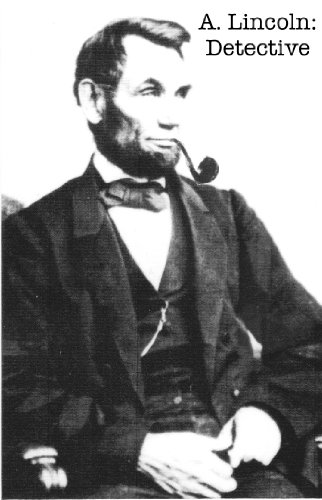
The picture at the head of this entry, Lincoln smoking a pipe, I cobbled together when I needed something as an illustration for the book when I put it up as a Kindle. I took a standard picture of Lincoln and put a calabash pipe – the sort famously smoked by Sherlock Holmes – in his mouth, attempting to make the visual point that the book was about Lincoln as a detective. It never occurred to me that most of the rest of the world wasn’t aware that Lincoln never smoked, meaning that most of the rest of the world missed my little joke. I even got emails asking the origin of this particular portrait of Lincoln.

So in my books, Lincoln doesn’t smoke, he doesn’t drink and her certainly never curses. Take a lesson, Spielberg. And check out my Lincoln version:


and