
I realize some of you have seen my new blog announcement on Facebook, if so, sorry, I don't mean to be piling it on here. For those who haven't, I have a new blog up at http://my69drinks.blog I'd like you to check it out and give it a month to see if you want to keep reading it. Reading it in order, starting with the one that is up now, will have it make more sense.
I consider those of you where were faithful followers of Thriller Guy a special bunch, and I thank you for hanging in there over the years. Perhaps you could consider becoming followers of the new blog as well. And for those who are waiting for TG's return, who knows, maybe he'll wander onto the pages of the new blog.
Thank you,
allen
Sunday, December 3, 2017


Thursday, June 29, 2017
So long, Thriller Guy
It has become obvious that the always shadowy Thriller Guy
has not made the transition from scarred urban warrior crouched in his basement
lair to the kinder hills and small towns of North Carolina.
I’ve thought about how to bring him to a natural, or unnatural
end. Maybe going down in a brisk pre-dawn firefight on some unnamed snow-capped ridge under siege from a legion of turbaned AK-wielding hajjis. He’d like that. Or
perhaps something more ironic, more absurd. I’ve always been amused by the
scene in the movie Who’s Afraid of
Virginia Woolf when George sits Martha down after a long night of drinking and
tells her, in Richard Burton’s solemn, sonorous voice, that their son Jim was
killed that afternoon on a country road… “when he swerved to avoid hitting a
porcupine and crashed into a tree.” How ignominious. How completely un-Thriller
Guy.
At any rate, it’s clear that he’s run out of writing advice
to sling around.
I began writing this blog almost exactly eight years ago. There have been 234, now 235, posts, and the
site averages a couple of thousand visitors a month. These are nowhere near
viral statistics, but in terms of years Thriller Guy has out-written probably
99.5% of all the bloggers who have declared their intentions and started in
posting on a dedicated site. Blogging is tough. My old, lamented, lost friend
Bhob Stewart used to say blogging was “public writing,” which is as good a
definition as I’ve ever come across. When you’re writing, it’s as if your
readers are in the same room with you, crowding around, looking over your
shoulder, nagging, “No, that’s bullshit, you’re an idiot,” as you struggle to
ignore their taunts. Then, you may ask, if it’s so damned difficult why are
there so many blogs? Because it’s also amazingly easy. All you have to do is
sign onto BlogSpot or one of the other sites and just start blathering. My rule
of thumb, or rather Thriller Guy’s rule of thumb, is don’t even call yourself a
professional blogger before you have at least 100 entries etched into the unforgiving
surface of the Internet. Then you can have a conversation with TG about what
it’s like to be a blogger, to come up with something new every time you sit
down at the keyboard and launch into another tirade. You think it’s easy
generating that much ire week after week, year after year?
I’m going to drop a bomb here: Thriller Guy is not real; he
is a character. I’m sorry if some of you have been misled over the years,
thinking that TG is a tough, kick-ass grizzled ex-warrior who learned to craft
novels and was willing to share his writing experiences. I hope you haven’t
been too disappointed that he never has had time to get together and have a
beer and toss around war stories with you as you’ve requested. I’m going to
give it to you straight: Thriller Guy is actually a portly old guy who sits in
his basement tossing out advice on how to write fiction, particularly
thrillers. TG has never been in the military. He has never heard a shot fired
in anger. He has little experience with guns. Thriller Guy has never jumped out
of an airplane or crept around behind enemy lines. TG has never even seen a
real pair of Night Vision Goggles.
TG is actually something of an asshole. As a writing coach
and mentor he was designed to be irascible, opinionated, taunting, and
sometimes cruel. I, his creator, was sick of all the well-meaning writing mentors
who pat wanna-be authors on the head and bestowed their gentle nurturing advice
as if writing was somehow special work, done by special people, for whom a
harsh word or dearth of praise would throw these aspiring “artists” into fits
of melancholy, from which stygian depths they would never arise to craft their
masterpieces.
No, it was always TG’s goal to give anyone who thought they
wanted to be a writer a swift kick in the ass in the hopes that reality would
kill off the weaker ones and dissuade those who didn’t have the stones to
continue in the face of unrelenting insults and ridicule. TG did not want to gently
bestow the lessons of his vast experience upon those supplicants who knelt at
his feet with their sad pleading eyes, TG wanted to take his experience and
beat them over the head with it. To chase them away, back to real lives.
Of course it didn’t work. Writers seem to have a
predilection for torture, probably because real writing is one of the worst
tortures that deluded humans can wish upon themselves. There is a romanticism
about writing that is completely misplaced, but the more a professional writer tries
to drive that point into the thick, disbelieving skulls of the neophyte the
more ridicule these greenhorns beg for. As if rejection is somehow honorable.
It’s not. It’s painful. And it’s unfair. And there’s not a
goddamned thing you can do about it. TG could teach you all the tricks of the
genre trade and you’re still not going to get your fair slice of the pie. The
system is rigged, as that asshole Donald Trump would say. As always it’s rigged
in favor of the guys and gals who are already making a ton of money, and it’s
rigged against any novice no matter how talented he or she may be. I know
authors who have a dozen published books under their belt and they
still can’t find an agent, much less a publisher. Self-publishing? Go ahead and
hang onto your inspiring, hopeful stories about guys like Hugh Howey making it
big by publishing his own stuff with Amazon. Unfortunately, you aren’t Hugh
Howey and your self-published book will probably sell around five copies. I
know this from my own experience. All of my books are available in some form on
Amazon. You can buy them here. But you probably won’t. Some of them sell
reasonably well, some of them don’t, and I don’t have a clue why there’s a
difference.
Don’t blame Thriller Guy for these sad truths. He tried to
stop you way back eight years ago when you came to him, begging in your
plaintive voice, “How do you do it, TG? How do you write a best-selling
thriller novel?” TG gave you all that he had learned over the years spent in
the filthy, cruel trenches of publishing. Parsed it out over 234 entries. All
the tips and tricks of the trade. And in the end it always came down to TG’s
mantra: Sit down; Shut up; Get to work.
That’s the secret. If you do that, you’ll write your book.
It’s that simple. And that difficult. What so many of you are asking for is not
how to write a book, but how to write a successful
book. How to make money writing a book, how to become famous by writing a book,
how to amass legions of fawning admirers by writing a book. Alas, Thriller guy
can’t tell you that. I can’t tell you that. No one is able to do that. And
beware those who tell you they have the secret and they would be glad to sell
it to you.
Annie Dillard writes in her book, The Writing Life, that after Michelangelo died, someone found in
his studio a piece of paper on which he had written a note to his apprentice,
in the handwriting of his old age: “Draw, Antonio, draw, and do not waste
time.”
Like the man said: Sit
down; Shut up; Get to work.
Here’s one last secret. TG wouldn’t want me to tell this
one, he’d be embarrassed to admit it, but over the last eight years he and I
have met, via the Internet, because of this blog, quite a few excellent
writers. Writers who, if they persevere
against all the terrible odds that TG has thrown at them, are going to write
terrific books. Who are in the process of writing terrific books. So we’ll let
TG go, at least for now, to wander off into some other reality. No more
yelling. This is me, Allen, whispering into your ear…
Hush, child. No more
questions. Sit down. Write. You can do this. Trust me. Write.
Onward. Always Onward.
Allen Appel
Written
in his studio aerie,
Overlooking
his back yard,
On
a lovely day,
June
28, 2017
Wednesday, March 15, 2017
TG Recommends
As regular readers of this blog are aware, Thriller Guy
doers not review many novels, and in particular his friends' novels, on these pages. TG has stated the reason
before, but if you missed it, he learned early on that when he recommended a
book, friend or not, someone always wrote in a comment complaining that the
book was crap and TG was a fool who had caused the commenter to waste whatever
paltry money he/she had spent on the book. This was distressing to the friend,
and even TG was discomfited. And as regular readers know, TG is a hard man to
discomfit. (Yes, TG just looked the word discomfit up and learned that it
originally referred to those who had been killed in battle. “The ground was
strewn with the
discomfited.” Stephen Crane)
 |
| Nancy Peacock |
But, even knowing that out there is some dimwit who will
probably write a crappy comment, TG is going to recommend a book by a friend: The Life and Times of Persimmon Wilson, by
Nancy Peacock. TG knows that this book is not a thriller, so please don’t write in pointing out that the novel is not a thriller. The author, who
lives down the street from TG, has an interesting publishing history. TG is
aware that many of his readers are writers. All writers are interested in how
other writers get published, particularly, these days: Indie publishing? Legacy
publishers? Self publishing? TG asked Nancy about her publishing experiences for
the blog. We’ll get to that in a moment; first, the book.
A former slave named Persimmon Wilson is accused of the murder
of his ex-master Joseph Wilson, and the kidnapping of Wilson’s wife. In the
street below his cell, carpenters are building his gallows. In the town there
is gathering excitement over the upcoming execution for Persimmon Wilson is
notorious. Not only is he a black man who killed a white man, and “degraded”
that man’s wife, but he is also the “black Indian” known as Twist Rope who
rode, raided, and terrorized Texas settlements and farms with the Comanche
Indians.
The book begins… “I have been to hangings before, but never my
own.”

Nancy Peacock speaks to Thriller Guy on her publishing
history…
"My first
novel Life Without Water was very well received. I published with a
small press without an agent. Lee Smith - another Hillsborough writer whom you
may have met - was my mentor and she mentioned my book to John Yow, editor at
Longstreet Press. She called me and told me to send him 3 chapters right away -
which I did. He convinced the house to take it on. The whole experience could
not have been better. Longstreet worked hard for that little book, sent me to
various venues, and got it reviewed in NY Times, Washington Post, and other
prominent places. The book was chosen as a NY Times Notable that year.
I sold my
next book Home Across the Road- agented - to Longstreet, and the
experience could not have been more different. Unbeknownst to me Cox Newspaper
that owned Longstreet was selling the house, and had found an in house buyer.
Knowing they had a buyer they did not care about the company, and the buyer had
not protected himself or his authors by having a clause in the contract saying
they needed to fulfill their current obligations. They didn't. At the time my
book was published and being reviewed (NY Times again, Southern Living -- it was
Christmas) it was not available on any shelves. The publisher had simply
stopped printing it. This was heartbreaking to say the least, and at the time I
did not know what was going on. It was later that I found out and pieced it all
together.
This
experience taught me that anything can happen in publishing.
Third book, A
Broom of One's Own: Words on Writing, Housecleaning and Life was sold to
Harper Collins. It is my only nonfiction book, and while it has received great
reviews on Amazon (Cheryl Strayed loved it) it has still not earned out its
advance yet.
So I was
pretty discouraged about the whole thing - writing and publishing - by the time
Persy strolled into my mind with that opening line. I knew I wanted to follow
his thread - his story - but I was so heartbroken over my publishing history
(it had basically gone downhill book by book) that it was difficult to want to
write it. I felt like I needed more control over my writing life (maybe what I
needed was lower expectations) so I told myself I was going to write this book
and self-publish it. I wasn't going to go through the usual channels.
This actually
turned out to be a good decision - for me, for the experience, for the indie
version, and also for the traditionally published edition that just came out.
Good for me
and the experience because I truly got to see how much work goes into producing
a book. Of course it's easier if you're a publishing company with lots of
departments than if you are an author doing everything. But, self-publishing is
becoming more respected, and in my opinion more necessary. The publishing
houses are interested in big bucks, which makes sense, but it also means a
writer like me is competing (and receiving less of an advance) than a celebrity
who isn't really a writer but is courted and given a book deal. So many authors
who are good writers and deserve success are being left behind, and it's the
publishing industry that's doing this. So self-publishing is, in my opinion, a
fine thing to do and a fine statement to make. In my indie journey though I met
a few snobs, people who assume an indie book is not a good book. And many are
not, but many are. (As an aside I think it would be great to have a well-respected
review newspaper that covers only indie titles) But I digress, apparently!
It was good
for the indie edition because The Life and Times of Persimmon Wilson won
the
Writer's Digest Self Published Book Award in the mainstream novel category.
It also won Shelf Unbound's Award for best self published novel.
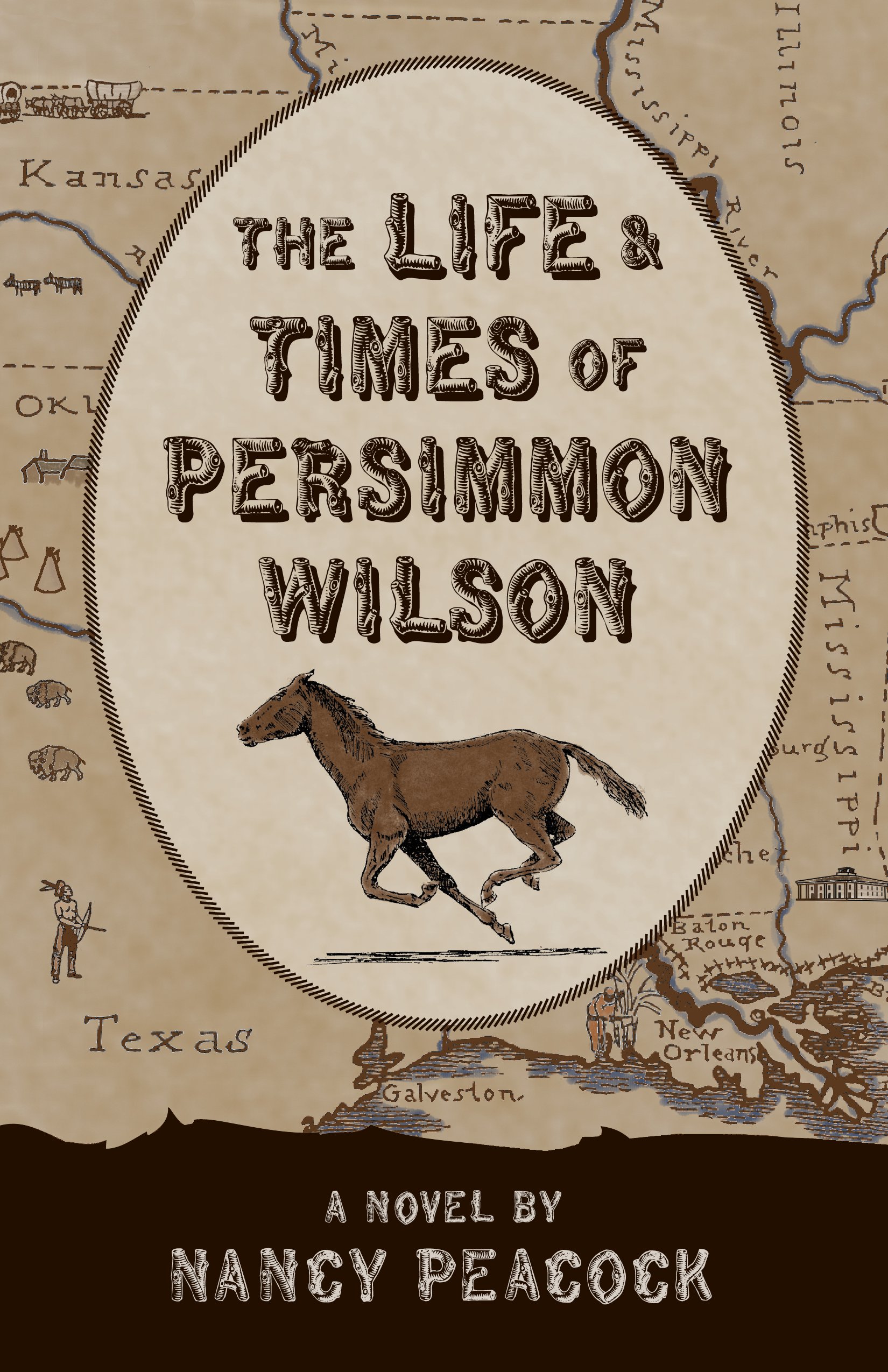 |
| Self published edition |
Good for the
new edition because I gathered blurbs for it and one of my blurbers sent it to
his agent, and that's how I landed a new agent. He liked the book a lot, but
when we initially spoke he felt skeptical that he would be able to sell it.
When it won the WD award he began sending it out, and within months had an
offer from Atria. I think this surprised him.
As I promote
the book, I never forget or hide my self publishing history. I'm proud of both
editions. Both paths are really difficult, and I wouldn't say one is better
than the other as a path to fame and fortune. The take away on traditional
publishing though is that anything can happen, so to think it's the sun of
glory and fortune is foolish. I was foolish when I first got published. I've
found the key to be lowering my expectations while at the same time maintaining
faith." Nancy Peacock
Next time TG
will discuss the lessons to be learned from this account.
Friday, February 3, 2017
Larry Speaks
Book Reviewers Can be Jerks
By Larry Kahaner
My pal Larry blogs at The Non-Fiction Novelist. This is one of his blogs about book reviews. As a professional reviewer I'm passing it along to those of you who have been reviewed in publications or are reviewed on your Amazon book pages. I review for a living (such as it is) and I put up reviews for books I like on Amazon. I also have been reviewed for my fiction and my non-fiction many times. The great majority of my reviews have been positive -- a reviewer at a small newspaper in the mid-west once declared my first time travel novel as "the best book that had ever been written," hah! and I have been denounced as a writer of "pathetic rubbish," so I've seen it from both sides.
Larry has an excellent new novel out, USA, Inc. Buy it and submit a review.

OK, back to Larry.
Whether you are a seasoned author or just published your first book, reviews play tricks on your self-confidence as a writer. Like everything else in life, some people like your stuff and some people hate it (thanks, Captain Obvious) and there’s nothing you can do about it.
Every book has its supporters and detractors, and if your head isn’t screwed on, it can be a career killer.
Let me stipulate up front that most reviewers, indeed, the vast majority of reviewers are writing honest, objective reviews. This blog is about the other ones.
I offer some points to remember if you decide to read your reviews. I say ‘if’ because many successful authors never read reviews. I used to think this was BS, but it’s true. These folks understand the reality of reviews.
And here they are:
- Reviews are supposed to be objective, but they’re not. Readers bring themselves into the review based on their own beliefs. Here’s a personal example. I published a book titled AK-47: the Weapon that Changed the Face of War. Pro-gun people said I blamed all the world ills on this ubiquitous weapon. Anti-gun people said that I glorified the weapon. Both can’t be true. Right? I even read one review that chided me for not including more pictures of guns. Hello… it was not a gun-porn book, but a political view of the world’s most-used weapon.
- Some reviewers and readers are pissed off about a specific subject matter so they give a low rating hoping that potential readers will ignore a book. Think books about climate change. Others love the topic so they give a high rating hoping that others of their ilk will buy it and somehow bolster the cause. Neither reviews have anything to do with a book’s merit. Case in point: I once wrote a book about a company called MCI (not the MCI WorldCom that was later involved in a scandal). The title was On The Line. The company beat AT&T in court and this opened the way for competitive long distance phone service. I got hate reviews from those who were angry that AT&T was no longer the country’s de facto monopoly phone company and venerable Ma Bell (youngsters, stay with me on this) was being broken up. Others were glad to see the old monopoly split into regional companies which eventually ushered in the telecommunications system we have today. I even received a letter from David Packard, head of Hewlett-Packard, chiding me for writing about this start-up company which he believed would lead to the downfall of Western civilization. What about the book’s merits? Didn’t really matter. And no sour grapes here by the way. The book did really well.
- Last one: Reviewers are swayed by what the reviewer thinks the author stands for. The classic case is Salman Rushdie who penned a novel in 1988 titled Satanic Verses, which caused a stir among many in the Muslim community. They accused Rushdie of blasphemy, and in 1989 the Ayatollah Ruhollah Khomeini of Iran issued a fatwa ordering Muslims to kill Rushdie. Many death threats followed and Rushdie went into hiding with armed guards. To show their support for Rushdie and their dislike of the Ayatollah many people bought the book – it became a best seller – and critics offered rave reviews because they supported free speech and wanted to strike a blow against radical Islam. It had been reported at the time that many Western consumers bought the book but never read it. They just wanted to make a point. Rushdie says he is not anti-Muslim. He was born into a Muslim family and now considers himself an atheist. By the way, many reviewers wrote about the controversy itself and not the book. That’s not their job.
My final point is this. You can’t please everyone. Mind you, I’m not talking about warranted, even constructive criticism, but make sure a review is about your book and not about you or anything else before you react. Write your book the best way you know how and work on having a thick skin or don’t read reviews at all. Your choice.
Coda: I have a good writing buddy who also is a reviewer for a respected trade publication. I often send him my blogs to gut-check them before posting. He had this remark: “Perfectly reasonable blog, though it will never make anyone feel better about a bad review. They always hurt, even if you know you were treated unfairly.”
—
Friday, December 23, 2016
Pie!

This entry should be on my memoir blog, but that’s on hiatus
at the moment, so I’ll put it here for now…
When I was probably around ten-years-old, right around
Christmas, I was walking by the Bonnet’s house up the street from us. They
lived on the corner of Maxwell Avenue and 19th street. They were a
numerous clan, I can’t remember how many kids there were, and they were a lot
of fun, parents and children. Mr. Bonnet was in the back yard digging in a snow
bank. As I watched, he dug up a large cooking pot, brushed the snow off and
went up on the porch. I asked him what he was doing. He told me he had made a
pork pie last night and had buried it in the snow overnight to solidify. Did I
want a piece?
Pork pie! I had never heard of such a thing and couldn’t even
conceive of it. Pies were sweet and they certainly didn’t contain meat. No
thanks.
Several years later I took him up on his offer of the
Christmas Pork Pie. Of course it was fabulous. I recently found Mrs. Bonnet’s
recipe in an old cookbook she wrote for her family. Here it is, in her words, a
Christmas gift from Thriller Guy, Allen Appel, and all the other Appels. It is
not necessary to bury the pie in a snow bank and let it sit overnight, but it’s
a nice touch.
Dick Bonnet’s Pork
Pie
“This recipe should be in a book by itself. It’s not a meat
recipe, or a pie recipe; at least not the usual meat or pie recipes. But it
definitely belongs in this book. It’s not something you can “whip up” in a
hurry, and certainly no way to impress guests, unless they are British.
It has always been dad’s late evening winter snack. Also,
Grandma has made it for all your Uncles and Aunts and has actually mailed it
on occasion. Absolutely indestructible!
The first time I ever went to visit Grandma and Grandpa
Bonnet, way back in 1947, we arrived in the late evening in a snow storm and
Grandma had made a pork pie for Dad. Maybe she wanted to discourage me! Anyway,
I ate it “to be polite” and have eaten it “to be polite” ever since. One
suggestion, don’t try to make it yourself until you have watched the master
(Dad) make at least one.
This is not an ordinary recipe – This is ANOTHER BONNET
CHALLENGE.
6 cups flour
1 ¼ cup lard
1 ½ tsp. salt
¾ c water
Boil lard and water until lard is melted. Add flour and salt.
Knead until smooth and elastic – about 10 – 15 minutes or when it no longer
falls apart and has the consistency of putty. Shape dough on a cookie sheet,
building sides about ¼” thick and about 3” high. So it will hold meat. Save ¼
of dough for cover.
Get a very lean piece of pork, about three pounds. I usually
get a fresh ham and use what is left for a small roast. A “picnic” shoulder is
cheaper, but has a lot more fat to cut off. Cut meat in ¼” cubes, cutting off
all fat. Meat cuts easier if it has been left in the freezer about an hour. Put
in a bowl and salt and pepper generously. Put pork in molded, unbaked crust.
Roll out top crust with rolling pin. Cover pie, pinching edges together so it
is tight. Cut an X in the center of top so steam can escape. Bake in oven for 2
hours. The last 20 minutes of baking brush top and sides with egg white or milk
to make it shiny. Raise temp to 400 degrees for last 20 minutes.
While pie is cooling, boil 1 cup water with 2 bouillon
cubes, one pk. Gelatin and an onion. Boil about 15 minutes. When pie is
completely cool, add this mixture to X in top of pie, a little bit at a time. Refrigerate
several hours before serving.”
Or, as noted above, bury in snow overnight.
Merry Christmas everyone. Don’t forget to go to audible.com
and order your audio copy of the Christmas classic, The Christmas Chicken. You
can listen to it while you cook up your Pork Pie.
Subscribe to:
Posts (Atom)