Wednesday, June 9, 2010

Thriller Guy Taken to Task


It seems TG has been stepping on a few toes. Well, it's what TG does best. This in from one of the blog's readers. The writer, Marc S. is well known to TG, being one of the writers in his writers group, The Squatting Toad, which TG wrote about in an earlier entry. Because TG prides himself on his ability to take it, as well as dish it out, he is running the letter in its entirety. And offering the same space to anyone else who would like to take TG to task. The offer is always on the table: Bring it on. (Note: Mark S. is far too modest in his letter: his novel was excellent and should be included on the list of "ones that got away.")

Dear TG,

It’s a hot Saturday afternoon and I’m sitting in my leather recliner catching up on your superb blog. I’m reading your recent entry about book signings with a frozen chocolate vodka in my hand. I note this particular flavored brand of alcohol is the subject of an earlier TG composition about the manly virtues of gin. TG implies that chocolate vodka is the preferred choice of men who prefer skirts to pants. “Less than a manly drink,” is what you called it.

The implication is somewhat odd since TG and I, as well as other members of the Squatting Toads, have drained one bottle after another of chocolate vodka over the past year, beginning when TG himself discovered the maiden bottle of chocolate vodka in my freezer and promptly opened it, beginning a trend. I’ve been hooked ever since. To this day, a bottle of the less than manly drink is an essential part of my terrorist survival kit, along with duct tape and 365 cans of tuna fish.

So does the preference for a candy-flavored drink rather than gin or scotch whiskey render me unqualified to write thrillers? Should I be writing southern love stories or tales of the Caribbean trade winds instead? If you believe my good friend TG, I should be banished to the Harlequin aisle and forced to wear a dress due to my preference for alcohol flavored by the cocoa bean. Pish tosh! I am quite secure with my manliness (how else would I be comfortable saying pish tosh?) I have a tattoo of a skull with a sword through it, embroidered with the words, Born to Raise Hell. I’m six feet two inches tall and weigh about 240 pounds. I was in a street gang in my youth. I played football in college and later rugby, whose players are known for eating their dead. Later in life I worked as an investigative reporter, pursuing mobsters who killed as a matter of business, and then as a government gumshoe. I doubt that chocolate vodka neutralizes my past. Chocolate, like any flavor, is but a veneer. The test of a man is beneath the surface, at his heart and his soul.

Is it the same test for thriller writers? Must they have the heart of a lion to write about the lion hearted? Are there personality traits common to the great ones? What do they drink? What type of woman – or man – do they prefer? Should female thriller writers be judged differently than men? Lots of question to mull over while sipping chocolate vodka.

I switch to memories of book signings. I’ve had one novel published, an obscure thriller called Dirty Laundry. A New York Times review briefly lifted it from obscurity, but it dropped to its natural level of mediocrity soon after. Maybe this is why I turn so often to chocolate vodka. Anyway, during the moment I hovered above obscurity, book signings were arranged for me. One of them was scheduled at Murder, Inc., a Manhattan book store owned by legendary mystery editor, author and publisher Otto Penzler. My wife at the time was from New York and had many relatives and friends, all of whom were invited to my coming out party at Penzler’s book establishment. But upon arrival at the bookstore there were no signs in the window announcing the book signing. Inside the store, there were no indications that an author, obscure or not, would be signing books that day.

I spoke to one of Penzler’s employees and inquired about my book signing. He said there must be some mistake. We have no book signing scheduled for today. I informed him I had invited more than 100 people. They would be arriving within the next 30 minutes. Didn’t you hear from my publisher? Oh yes, he recalled, someone did call. But the arrangement was for you to sign books, not have a book signing. I told him I failed to see the difference. He explained the publisher delivered a hundred copies of my book, which I would sign, and they would be sold as signed copies. But a public signing, where people stood in line waiting for my autograph was not anticipated. Had I known about chocolate vodka at that time, I might have poured one or smashed the bottle over his head, but instead I demanded that a book signing, not a signing of book, be arranged, and in short order.

Otto Penzler arrived in the middle of the contretemps. He graciously offered his upstairs office, a loft above the store, as the signing area, and personally cleared the clutter from his desk so I could use it as the signing platform. Relatives and friends soon arrived and no one was the wiser. The signing was a success and I slipped back into obscurity, where the chocolate vodka is cold and anonymous, and TG and the Squatting Toads offer comfort, even to a girly man.

One more related anecdote. During my two seconds of literary recognition, I was invited to interview Robert Parker before an audience at the Smithsonian Institution in Washington, D.C. I brought a signed copy of my novel with me. During the introduction backstage I gave my book to Parker, figuring he would read it that night and call Hollywood the next day, demanding my book be turned into a movie. We went on stage, where I interviewed Parker and fielded questions for him from the audience. I remember Parker wore loafers without socks and I couldn’t decide if he was being chic or crude. I probably stared at his bare ankles too much. Maybe that’s the reason I found my book under his chair when he left the stage. As the audience emptied the auditorium, my dreams of Hollywood went out the door with them, as did Parker and his damn naked ankles.

By the way, vodka comes in all sorts of sissy flavors, including lemon, orange, kiwi, pomegranate and strawberry. Also potato and bacon. You can even mix them all together if you’re a true girly man.


Saturday, June 5, 2010

Booksigning Hell

 
Parnell Hall is a mystery writer who has been around the block about as many times as Thriller Guy. Parnell began his career in 1987 with a mystery, Detective, featuring a reluctant private eye named Stanley Hastings. This is an ongoing series with 17 entries so far. Parnell shared a publisher with TG, Carroll and Graf, for a few years back at the turn of the century when the estimable Kent Carroll was running the company. Oh, those were heady times. TG hasn't read a Parnell Hall book in years, not since TG became the goto thriller guy for many, many review outlets and hasn't had the time to read for pleasure. TG assumes that Parnell is just as funny and astute as he was back then, and recommends his books without reservation. All of this is leading up to a very funny film/tape/internet clip where Parnell sings a song about the trials of the book signing. It always sounds somewhat churlish to complain about this aspect of Big Time Book Publishing, at least to those who would sever any number of appendages just for the opportunity to publish a book with a regular book publisher, but, really, and TG would never lie to you, doing a book signing can be one of the most excruciating experiences that a human writer can experience. And TG, in the guise of his alter ego, Allen Appel, has done plenty of them. More than he can remember. More than he wishes to remember.


TG can relate many stories of sitting in bookstores with a monkey-like grin plastered on his face, watching patrons entering the bookstore and scurrying along the edges, hiding behind shelves, staying as far away from the dreaded author table as they could possibly get. God forbid they would engage the author in conversation, find him and his book interesting and actually buy a copy. A signed copy. Civilians hear about Stephen King and Neil Giman and other Triple A authors making bookstore appearances and having buyers line up around the block. But the norm is that the lonely author sits there in the bookstore for two or three hours and if you sell ONE book it's deemed a success. Welcome, Little Ones, to the world of Big Time Publishing. The experience is mortifying and boring in equal parts; the bookstore owners look at you with pity and sometimes anger at having shelled out for a crappy cheese, salami and Triscuit plate that no one, not even the most underpaid staff is interested in. On more than one occasion when there was cheap wine, TG has been known, sadly, tragically, to get drunk all by himself, watching the slices of American cheese begin to curl and the salami sweat. All alone at his stupid table, books piled high around him, has favorite pen at the ready.

One of the worst was an interminable hell TG spent in a downtown mall in Charleston, WV, at a table off to the side on the basement floor under an escalator where there was absolutely no foot traffic, where there was only Bob Denver, the guy who played Gilligan on Gilligan's Island. He was flacking some book he had written about his experiences, (TG is not going to bother looking this book up for a link, anyone who feels they want a copy can do it themselves.) Gilligan was wearing his stupid little hat and every once in awhile someone would wander up and shake his hand, and finally he sold a book. TG didn't sell any. Denver spent his time sort of talking to himself, striking odd poses in his chair, and acting as if he were drunk, which he may have been, or maybe he was just goofy. Hey, you wanna be a writer? Do you really want to sit next to Gilligan? And have him outsell you?

Any professional writer can tell you any number of these stories. The only time TG ever beat this system was when his alter ego, Allen Appel, wrote a book called Old Dog's Guide to Young Pups, which sounds dumb but which is actually very funny. It's out of print, of course, but can be found on the Web and TG recommends it as a great gift for any dog owner or dog lover. TG even has some copies lying around that he'd be glad to sell you. First person who requests it gets a free copy. Anyway, for a brief period, Appel would do signings for this book and take along his old dog, Duchess, who was a rescue dog and a real mess (if anyone expresses interest, TG will put up an essay about this crazy little dog.) Duchess would sit in a chair alongside Appel in a bookstore and people would flock in and crowd the table to pet the dog and buy the book. Appel sold a ton. He even had a little dog footprint stamp so Duchess could sign as well. Cute! Then the publisher discontinued the book, because that's what they do. God knows why.

Does TG sound a mite peevish? Ungrateful? Let's hear from some other authors out there. Writers who have sat at the Table of Shame. Who have been scorned and shunned by those who slink by, looking at you as if you should have a bell around your neck. Leper! Leper!

TG's advice to author's contemplating a store signing? Adopt a dog.

That way you'll have at least one friend at the table.


Thursday, May 27, 2010

What Are You Wearing Right Now?


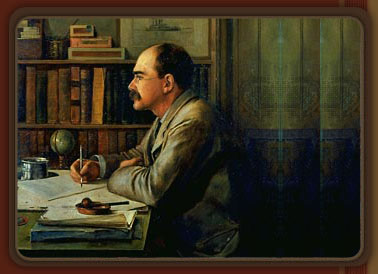
Recently while perusing a back issue of the New York Times Book Review, TG came across a review of some old famous writer, TG can't remember who, exactly, but this sharp scrivener was pictured sitting at his typewriter beavering away, wearing a three piece suit. You know the sort of picture, Somerset Maugham maybe, Dashiell Hammet, Hammet always wore a suit, J.P. Marquand, somebody. So of course as soon as TG started looking for a picture to use in this entry he couldn't find any pictures like he thought he saw. The Conan Doyle on the left was the closest he could find. Of course there's always Rudyard Kipling, (see below) he probably slept in a wooly tweed suit. But here's the point, one of the few perks of being a writer is you don't have to get “dressed up” to go to work. You can stroll downstairs, or upstairs, as the case might be, wearing pretty much anything you want. Who's going to see you? Yeah, maybe your family, but they don't have any respect for you anyway, so they don't count.

TG's everyday writing garb? Summer: Black T-shirt, black jeans, sneakers. Winter: Black mock turtleneck, black jeans, sneakers. Keep it simple. No muss, no fuss when rooting through the shirt drawer. But how about these guys who put on a suit to sit down at their desk? Maybe they've got something there. Maybe if you dress up, YOUR PROSE DRESSES UP! Maybe you write better if you dress better! So TG decided to get up this week, take a shower first thing and put on his suit, fresh and ready for a hard day's work. Suit? you may ask?

Here's the reason TG actually owns a suit...

Several years ago TG put together a book with his pal Mike Rothmiller, My Hero, which is a cool little book. The book caught the attention of then president George Bush, or rather it caught the attention of his wife. She decided that it would be good to have a ceremony in the White House where George would come in and receive a copy and give it a plug. Great, right? Sell a million copies. Well, TG was anything other than a Bush fan, so this rankled. TG's wife, World's Biggest Liberal, said what the hell, how many chances do you get like this? So TG said OK, even though it meant buying an actual suit. Which he did. It cost $400.00. More with a decent belt and a pair of shoes that weren't sneakers. So everything was running along smoothly, when one of the Bush girls, don't ask TG which one, decided to get married on the same day the book thing was suppsed to happen. So they canceled, those ingrates. TG didn't even try to reschedule since it wasn't something he hadn't wanted to do in the first place. The little book is still cool, check it out here.

That's why TG actually owns a suit.

So this week, TG was going to get up, put on his suit and tie and sit down at the computer and write some excellent prose. You know what? It's too much trouble. Besides, no one is here to take a picture. And if there's no picture it didn't really happen anyway.

So what do you wear when you write? Does it matter?

Here's a few others...

Mickey Spillane:

Rudyard Kipling:


Friday, May 14, 2010

Thrillergal

Thrillerguy has recently read several thrillers written by women. This is fairly rare, maybe three or four out of a hundred are written by women. Usually these books are indistinguishable from those written by men. A good example of the latter is the work of Stella Rimington who was the first female director of Britain's MI5. After retirement, she's written three thrillers, perfectly good books one supposes, though TG has only read and reviewed the second, Secret Asset. The point is, this book, and most of the other thrillers written by women, could just as easily been written by men. Even though the protagonist is usually a woman.

Not so Intelligence, a debut effort by Susan Hasler. Hasler went to work for the CIA in 1983 and stayed for 21 years. This makes her an insider, and as any reader of this blog knows, TG hates (usually) insider writers. Except in Hasler's case. Somehow, against all odds, she's that complete rarity: a female writer working a traditionally male field who not only dominates the traditional tropes but is able to put a female slant on the writing and story that makes it different from that of the usual male vantage point. And different in a good way. Hasler uses her insider knowledge in a way TG has never read in any other CIA thriller. She uses terms and categories that sound absolutely authentic, even though TG (whose knowledge of the genre is encyclopedic) was taken by surprise. This is surely the way the CIA is organized, the way they speak, the way they think. If it isn't, TG doesn't want to hear about it. TG is a believer in Susan Hasler's world.

Why aren't there more thrillers written with this special slant? Not the insider terminology, but the insider knowledge of being a woman. Books, thrillers that are written from a female POV. Because TG feels that these days that anyone who still thinks that men and women are essentially alike is a moron. Grow up. The sixties, (though oh how TG loved the Sixties) are over. TG says read Susan Hasler's Intelligence because it's good and it's different. In a world of fiction where one book seeks to copy another, any other successful book in the hope that that book will then become successful, is a world that TG is heartily sick of. (of which TG is heartily sick.) Please, no more Dan Brown copies. No more CIA thrillers just like all the other CIA thrillers. Let's have more women being smart, being tough, being women for Christ's sake. And all that implies.

As always, TG will try and contact Susan Hasler for a signed copy of Intelligence, one that will go this time to the first woman commenter. And if there are no women commenters, then a lucky guy will get the book. Trust me, this is good stuff.

Thursday, May 6, 2010

The Killer


Back when Thriller Guy was writing movie scripts he read an interesting piece of advice on how to craft a good action/adventure film. Scripts are short (each page equals one minute of screen time, hence around 100 to 120 pages) and they are traditionally divided up into three acts. To understand this soon-to-be-revealed piece of advice, you should know the screenwriting definition of the word “whammie.” A whammie is anything exciting, usually an explosion, car chase, gunfight, anything that gets the viewer's blood pumping. Here's the advice on how to structure your script:

Act One: Whammies.

Act Two: More Whammies.

Act Three: All Whammies.

With his recently published The Killers, Tom Hinshelwood has written a thriller that is all whammies.

The primary elements are not all that unusual – a CIA traitor, hired killer, beautiful agency operative, Russian spies, and an espionage coup of invaluable proportion, betrayals and double crosses – but what he does with them is a steely, joy to read: a thriller that kicks ass from beginning to end without any sag in the middle, no fussy romantic entanglements, no cliched backstory that attempts to explain the psychological origins behind the ongoing mayhem. This book slams into gear from the first pages and roars along till it smashes into the end. Terrific.

Victor is a hired killer who is coldly efficient. He's doing a hit on a Latvian national, killing the man and retrieving a small flash drive. When Victor heads back to his hotel he has to fight his way through a gang that suddenly attacks him. From then on legions of other hit men try to take his life, eventually culminating in an assassins duel between Victor and another hired killer, Reed, who may or may not be his equal.

There's a scene soon after Reed is introduced where he is attacked, randomly, by a gang of street punks. Thriller Guy loves these scenes which are often found in thrillers. The street gang shows up, hones in on the professional, and you just know what is going to happen. Here, the leader of the punks demands that Reed hand over his wallet, phone and watch:

     Reed's expression remained blank. “Why?”
     “Say what?”
     In that moment when confusion combined with anxiety, Reed grabbed the outstretched arm before him, wrapping his left hand around the wrist and pulling the kid forward sharply, directing the gun away to the side. He took hold of the kid's triceps with his free hand and twisted the wrist in his grip, locking the arm. He wrenched it downward, hard – against the joint – snapping the arm at the elbow and into an inverted V.
     The gun clattered on the asphalt and the awful wail momentarily stunned the others. Reed released the wrist and the kid collapsed. Among the screams he managed to find his voice.
     “FUCKING KILL HIM.”
     Reed sprang forward toward the other drawn gun, knocked the weapon aside as it was raised to fire, using his forward impetus to multiply the force of the elbow he sent into the kid's face. His head snapped backward, blood splashing from his mouth and the kid went down heavy, out cold, jaw broken.
     The other youth armed with a gun backed off, palms showing, eyes wide, head shaking. Reed ignored him, heard the click of a switchblade opening, turned, sidestepped as his attacker lunged and overextended himself into empty air, stumbling, completely off balance, arms flailing.
     The next one came from behind, his feet scraping on the ground. Reed whipped round, threw the edge of his hand into the guy's throat. He fell down convulsing.
     Two more attacked at the same time, one wielding a hunting knife with a four-inch blade, the other a crowbar. The crowbar came at him first, from the left, swinging for his head. Reed caught it and the attacker's hand together, redirected it downward, using the kid's momentum against him to twist the bar from his fingers and into Reed's own.
     He smashed an elbow into the youth's side, knocking him backward, as the youth gasped, ribs cracked. Reed followed through with the crowbar, backhanding it into the side of his attacker's skull. Blood splashed on faces in the crowd.
     The hunting knife passed within inches of Reed's face, a wild swing, clumsy. Reed dodged backward, waiting for the next attack, used his forearm as a shield to turn the blade aside and the crowbar to sweep his attacker's feet out from under him and drove it down into the kid's face, exploding his nose across his cheeks.
     The small youth with the switchblade recovered and yelled as he attacked again, a frenzied stab. Reed dodged, invited another attack, and brought the crowbar down hard on the youth's exposed arm, shattering bones. He screamed and dropped the knife, wrist and hand hanging limply from mid-forearm. Reed reversed his grip on the crowbar, swung it upward, cracking the youth under the jaw, the force lifting him off his feet and dropping him back to the ground in a silent heap.
     It was all over in less than seven seconds.

This is pretty much just a throwaway scene, tossed in for the sheer, exuberant love of havoc. Hinshelwood cranks this stuff out by the ream, making it look easy when TG can assure all you writers, published and unpublished, out there, it isn't. It's damn hard to do a few times, much less over and over the course of the entire book. And without repeating himself, without, dare I say it, becoming gratuitous. Whenever an ass kicking comes, it is always well deserved and functions to move the plot forward. The point of the above scene: don't screw around with Reed. If you do he will kill you.

TG will contact Hinshelwood and see if he'll donate a signed book to the first one of TG's readers who requests a copy. Maybe TG will do a small interview and find out where the man learned to write and to kick butt. So let TG know if you want a copy. And remember, all you Thriller Writers:

Whammies.

In the end, it's all about the whammies.

Wednesday, April 28, 2010

Into the Bottle, Once Again


An aside: In the last two weeks Thriller Guy has read and reviewed three books with some form of the word “betrayal” in the title. Enough, publishers, let's use a little imagination!

OK, back to the topic under discussion.
When TG was just growing into manhood, his father took him aside to offer the following advice. “There are two rules our family has about drinking: 1. We take our iced tea without sugar;  2. We drink our liquor straight. Now get the hell out of here.”

Damn good advice; words of wisdom that TG has followed down these many long years. Old dad drank scotch, so that's what TG learned on, as it was the only liquor in the house to steal. TG and his pals would pour off some of whatever booze their parents had, not enough for it to be immediately noticeable, and then meet up of an evening in the city park where we would dump it all into one bottle (that would be scotch, sweet wine, bourbon, rye or anything else, all mixed together) and drink it until we were pretty high; then we would shoot each other with guns. My friend Steve Widemeyer had a derringer he stole from his father. It was a .30 caliber, but Steve found if you loaded it with a .22 shell with a matchstick jammed under it, the gun would fire just fine. We'd get sort of drunk and then Steve would shout “Run!” and everyone would take off in all directions and he'd shoot one of us. The bullet came out kind of rattling around at less than full speed, but it would hit you in the back and it would hurt like hell. How's that for stupid?

There is a current rage in TG's writers group, Squatting Toad, (see earlier entry about this group) for drinking chocolate vodka. Yes, it tastes good, but TG feels that this is less than a manly drink, maybe OK for mystery writers and hack poets, but Thriller Writers? No. Back when TG was with the “Boats” if that was your drink of choice you'd have gone to bed in your rack and awakened head-first in the latrine, dumped there by your buddies. And TG's daddy would have approved. Those boys drank beer and whiskey and didn't mix candy bars into the equation.

TG does love a great scotch and the newish single malt bourbons in this country are excellent libations. But until some astute publisher decides to pick up one of TG's novels currently being flacked by his agent, (those interested can contact TG through his alter ego or his first-class, really smart, very cool agent.) TG will have to stick to gin. Not that there's anything wrong with that. Gin has a long and esteemed pedigree and in eighteenth century England enjoyed a period of popularity that threatened to, at least according to the government, destroy society, at least among the lower classes. In 1743 the people of England were drinking 2.2 gallons of gin per head. Contrast that with American drinking of all spirits at .73 gallons per capita. (2007 data) We've become a nation of namby-pamby teetotalers. Wake up, America. For an interesting look at the 18th Century gin craze, click here.

TG believes, and this is after years of dedicated research, that the finest gin in the world, at least that's easily available in this country, is Hendricks. TG has long been a Tanqueray man, but after recently working his way through a giant bottle of Hendricks he now declares it his favorite. The problem is, it's expensive. Once this current bottle is empty (it was a birthday present from TG's excellent son) it's back to the cheap stuff. TG feels that it's easy to buy a superior product of anything if you throw enough money at it, but the real trick is finding something inexpensive that still remains of real value. So, as promised in an earlier blog, (insert drum roll) the winner of the Best Cheap Gin In America is... Burnett's. It's hard to get much, or any cheaper, than this gin, and yet the quality is high. Or at least high enough. It's usually found on the bottom shelf of your local liquor store, down with the real rot gut, in the clear green bottle. The convenient plastic bottle is just fine; when it slips out of your drunken grasp there's no chance of breakage. It runs around $15.00 or less for a half gallon, which makes it affordable to writers everywhere.


Give it a try. In the spirit of hewing to some modicum of responsibility, TG asks once again that you drink heavily only when you are in the throes of Writer Hell, unable to solve that difficult plot problem, title search, structural conundrum or any other problemo that faces real writers every time they sit down at the word machine. See the entry directly below for instructions on that particular process.

So how about it all you Real Writers out there? Any suggestions on types of or specific brands of liquor employed either for general enjoyment or particularly in the service of solving stubborn writerly problems? TG is here to learn.


Sunday, April 18, 2010

Alcohol and the Writer, Part Two


The above photo was taken by Thriller Guy's daughter as she and TG were tucked into the Lee Street Lounge in Charleston, WV, a cozy neighborhood bar suggested by TG's brother-in-law, Francis Fisher.

Part Two.

One of the troubles with blogs is they live life backwards. Thriller Guy is presently caught in the throes of explaining why drinking (alcohol) can be helpful to your writing. So if you are new to the blog, or at least new to this thread, take the time and read the entry directly below this one. The rest of us will wait while you do so. (Sound of fingers drumming impatiently on tabletop.) OK, TG is tired of waiting any longer.

Lawrence Kasdan, the screenwriter, (Body Heat, The Empire Strikes Back, Raiders of the Lost Ark) once said, “Being a writer is like having homework for the rest of your life.” Absolutely true. It is one hell of a lot of work. Writing is much more (though civilians don't understand this) than just putting a story down on paper. The structure of what one is attempting to write is at least as important as the characters, the voice is all important, the damn title is crucial. As you work your way through a 500 page manuscript, the plot must, and will, shift and break out in directions you never envisioned, at least at the beginning. There are scores, no, hundreds of decisions to be made and problems that have to be solved along the way. And no one is there to help you work through them. You're on your own, Bunky, so shut up and start writing.

But first, maybe it's time for a drink.

Here's TG's take on the situation: A writer's mind never stops working, (remember having homework for the rest of your life?) at least while you are actively banging away on a novel or even thinking up a novel. When TG is immersed in the process, he is up and down at least a couple of times every night, getting out of bed to write down stray bits of prose or solutions to problems that have arisen during the day. But sometimes TG gets stuck, and no matter how hard he thinks, he can't come up with an answer. Samuel Clemens (Mark Twain) used to say that whenever he would finish writing a novel, he was empty. That he could not write another word. He had no ideas about what he would write next, no creative thoughts whatsoever. But if he waited a night, a day, a week, the “well” (his creativity) would fill back up and before he knew it, he was back working on his next project. TG has found, over the years, that sometimes the solution to thornier problems involves just STOPPING his brain from working, taking a break from the constant barrage of problem-solving and word creation. At least for one night. And the best way to do this, at least for TG, is by drinking. (Twain was a great drinker. He left his wife written instructions that she was to, everyday without fail, put a shot glass filled with whiskey on his bathroom sink so that in the morning he could brush his teeth then down the shot of whiskey so his day would start out in the right direction. This is not something TG has ever tried, but, the man was one of our greatest writers. Maybe he was on to something.)

Sigh. TG is going to get so much grief from suggesting this problem-solving method. Let's all try and remember such drunks such as John Cheever, Dylan Thomas, Raymond Carver, Edgar Allen Poe, Ernest Hemingway and a host of others, all alcoholic, all doomed by their alcoholism at least to some degree. For more on the perils of the bottle, go to this article, which is titled Writers and Alcohol and appeared some years ago in The Washington Post. It contains the authoritative statement, “ More writers die of cirrosis of the liver, a disease associated with alcoholism, than people in other occupations.” so Be Warned. Please, do not take TG's suggestions here as license to drink to excess, to sink into the slough of alcoholism thinking you are just working out your plot. Use your head, people.

Here's the deal: say you've got a problem that you can't figure out – your character has been captured by an evil CEO and Our Hero is imprisoned in a laboratory where the resident mad scientist and his minions are threatening to suck the very essence out of his body. (Think Neo in The Matrix) How is Our Hero going to escape? TG can tell you from long experience, if you don't know how to get your man (or woman) out of this pickle when you head into this scene, the answer is probably not going to just jump into your head. Trying to hammer out a solution to a problem like this can drive you nuts. What you need to do is to stop trying to figure out the answer, and let your subconscious come up with a solution. To do this you need to stop your brain from working so hard, to let the well fill up, by itself. Send the kiddies off to bed (if there are any kiddies) kiss the wife goodnight, (if there is a wife) pour yourself a stiff drink and settle into your chair. Then have a couple of more drinks. You can noodle away at the problem while you're sitting there, but only in a general way. Drink too much, stagger off to bed, and go to sleep. And if you're lucky, the next morning, when you go back to work, the answer will pop into your head. Almost unbidden. Ditto if you're trying to come up with a title, solve a plot problem, searching for a “voice” to tell your story, a structure on which to build your novel. You need to stop trying to sove the problem, and let your writer's brain solve the conundrum on its own. This is actually one of the few thrilling moments when being a writer seems almost like magic.

So...when the Little Ones gather at TG's knee and ask such questions as, “Please, sir, I don't know how my story is going to end, how will I ever know?' TG tells them, relax, just write your book, the answer will come if you just let it alone, if you just stop trying so hard. And if it doesn't, have a drink. Or two, or more. And it will come to you as if in a dream.

Trust me.

Stay tuned for Alcohol, Part Three.

And here's another photo of the Lee Street Lounge.