Saturday, February 26, 2011

Shameless Plug

Many of the astute readers of this blog have tumbled to the fact that Thriller Guy often writes under the pseudonym of Allen Appel. Appel has written many books, both fiction and non-fiction, and he is proud to announce he has just published a Kindle edition of his heretofore unpublished novel, Abraham Lincoln: Detective. This novel is written from the point of view of Lincoln's law partner and biographer, William Herndon. It's based on a case that Lincoln wrote about himself, the Trailor Murder Mystery. Lincoln begins a letter to his friend Joshua Speed about the Trailor case thusly: Dear Speed: We have had the highest state of excitement here for a week past that our community has ever witnessed; and although the public feeling is somewhat allayed, the curious affair which aroused it is very far from being over, yet cleared of mystery. Because Lincoln was never able to solve the mystery, Appel has done so. The book is available to all you Kindle owners here.

Appel did a great deal of research on Lincoln for the last entry in his series of time travel books, In Time of War. During the course of which he discovered new Lincoln material that had never been made public. One item was a list of the 39 murder cases in which Lincoln was involved as the defense attorney. He lost only one of them (his client was hung) and some of them he was involved in only tangentially, but there were seven or eight that were very interesting that are virtually unknown. The most famous of these is known as the Almanac Trial, which many people have heard of, but there were others that had never been written about. Appel decided he would start a series of novels with Lincoln and Herndon playing the Holmes and Watson roles. Abraham Lincoln: Detective, is the first of the series.

Why Kindle? This novel is one of two that Appel's agent has been peddling around NY for some time. The last several years have been a terrible time to sell manuscripts. Publishers can be a cowardly sort, unwilling to try anything new, continuing to whine about the business while squeezing their a-list authors to produce books that are known quantities, no matter what the quality. They are content to rest their fortunes on a book-buying public the majority of which is perfectly happy with more of the same, no matter that the product is stale, off the shelf rehashes of what their big sellers and their imitators have been cranking out, year after year. Hence the scores of Da Vinci Code knock-offs that Thriller Guy has to wade through every month. So why not give Kindle a try? Just owning an e-reader puts an individual into a category of eager, intelligent book consumer willing to try something new. Sounds like a perfect market to TG.

If you have a Kindle, the link at the end of the first paragraph and again here will take you to Abraham Lincoln: Detective. If you don't have a Kindle you can download a free App that will let you read Kindle books on your cellphone, or even your PC or Windows computer. So now nobody has an excuse to not join the 21st Century.

You can also go to the Amazon Kindle store and browse around amongst the hundreds of possible good reads. Yes, much of the independently published work is crap, but as Theodore Sturgeon once famously said, while rebutting the naysayors who declared that 90% of science fiction is crap, “Ninety percent of everything is crap.”

TG says give the book a try. It's good. And when has TG ever lied to you?

Wednesday, February 16, 2011

Jigme Norbu

I'd like to call a pause in my usual ranting about publishers, agents, editors, writing and books to comment on the death of a very good man.

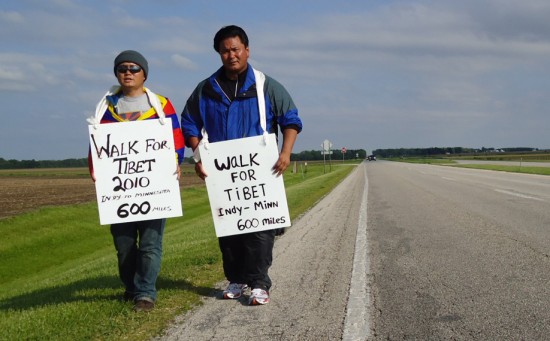
Several years ago I was driving through West Virginia coming home from a visit with my aging mother. It was an overcast day, cold and rainy, and I was speeding up the side of a mountain. There were no other cars in sight. Up ahead, I noticed two people wearing cardboard signs walking at the side of the road. My first thoughts were how rare it was to see anyone walking along the road, my second was to wonder if they had hiked up the entire length of this extremely long and steep incline and my third was what the hell were the signs going to say. As I blew past them at 75 miles per hour I read Walk For Tibet.

At that speed one can go some distance while the brain processes an anomaly like this one. I'm a guy who, once started on a long drive, will go to any lengths to not stop or divert from my path, but this was so unusual I decided to go back and see what it was about. Remember, this was West Virginia, not Berkley, California. It took awhile, but I finally came to an exit, got myself turned around and then turned around again so I could pull off to the side of the road.

Jigme Norbu and Wangchuk Dorjee told me they were walking across a large chunk of the United States to draw attention to the plight of Tibet. We didn't spend much time on politics as I was aware of Tibet's woes with the Chinese. I talked to them about how hard the walk must be, but both were cheerful and completely upbeat. Norbu put a little camera on the trunk of my car and took a picture of the three of us, his arm around my shoulder.

There are small and large moments in life that ring true and clear. Sometimes we notice them, sometimes we don't; this was one of those moments for me. I asked if I could contribute to the cause, he said sure, I retrieved my wallet from the car, found I had one lone twenty dollar bill, which I gave to him. I also found a bag of pepperoni rolls, a West Virginia specialty and my road-food of choice, which I also gave to him. He cheerfully accepted and made appreciative comments about the rolls.

Just as there are certain moments of truth, there are certain people we run across who embody those truths. Jigme was one of them. If I were a younger man, I would have happily asked for a little help from these two, pushed my car over the edge of the cliff and joined them on their trek. I didn't, of course. As I drove away I looked at them in my rear view mirror; they were headed down the hill, Wangchuk gaily swinging the bag of pepperoni rolls. That night I went on Jigme's website where he was chronicling his walk and found the picture of the three of us and a short note of thanks for “the West Virginia bread.”

By then I realized that they couldn't have eaten the rolls as surely they were vegetarians, but part of me hoped they could have at least nibbled away the exterior and left the pepperoni along the trail for the wild animals. I fired off a donation check to help them with their cause and put the experience down on my life list of unexpected moments of grace, sure that Jigme would walk on an on until his country and his people were free.

Yesterday I read that Jigme had been struck and killed by a car while walking down the highway in the dark in Florida. It shouldn't have surprised me -- walking in the dark on the edge of a highway can be dangerous -- but it did. And the depth of sadness that struck me also surprised me. After all, I had known, if known is the right word, the man for only a few passing moments. But there was something about him, that something that I am struggling to describe, that is rare, that we seldom come in contact with in our ordinary lives. This is the part where, if it were a better story than it is, I would announce that I have thrown off the shackles of my mundane life and was headed out to walk beside the highway with a Free Tibet sign. But I'm not. That's not my path. There are other Jigmes out there walking hard roads for good causes, and I salute them. It is not in me to give up the pepperoni in the roll. I can only say the world was a better place with Jigme Norbu and his friends in it, and a sadder place without him.

Walk on, Jigme, walk on.

Tuesday, February 8, 2011

TG Errs Again


As the intelligent Sparky points out in her comment on the last entry, Max Perkins was F. Scott Fitzgerald's editor, not his agent! (Sound of TG slapping his forehead.) Of course he was, TG knew that, he was just carried away with his rant about Agents These Days and how good writers used to have it back when men were gentlemen. So here's the story...

Fitzgerald had two agents, Harold Ober was his East Coast literary agent and his Hollywood agent was H.N. Swanson. Swanson was the far more interesting of the two; TG will get to him in a moment.

Ober graduated from Harvard in 1905 and two years later became a litereary agent. He opened his own agency in 1929 and represented authors such as Fitzgerald, Agatha Christie, William Faulkner, Pearl Buck and J. D. Salinger, among other writing luminaries. His agency, which is about as blue chip as it gets, is still in operation though Ober died in 1959.

Now for Swanson, known to one and all in Hollywood as Swanie. There's a good article from People magazine about him, which is where TG stole most of the following info.

In 1924 the 27-year-old F. Scott Fitzgerald asked H.N. Swanson to read his just-completed novel, Trimalchio in West Egg. "I told him it was the best thing he'd ever written, but I told him he had to change the title. The one he had wouldn't sell eight books. He asked what I had in mind. 'Gatsby.' I told him. 'The Great Gatsby? Scott was a smart man. He took my advice."

Swanie was Clark Gable's friend and golfing partner, he lunched with Disney, barhopped with Bogie and partied with the wild Fitzgeralds. (At one soiree Scott gleefully emptied guests' handbags into a kettle of water, then brought the brew to a boil.) In the early 1940s he negotiated a $750-a-week screenwriting contract for Raymond Chandler, then an unknown. ("He was an odd man, but he could write like a fool and had a great cynical flair for screenplays.) Swanson claimed that Heningway "didn't have a friend in the world and couldn't write without booze, which was true of many of my writers." (TG has discussed this in an earlier entry). Swanie introduced Faulkner to producer Howard Hawks, gave screenwriting tips to Fitzgerald and discovered Elmore Leonard in the mid-'50s. "He was a pup writing Westerns," Swanson said. "I told him to forget the cowboy stuff and write stories with women in them. He did, and I made him a millionaire."

Swanie worked hard right up until the end. He was 90 years old when he landed a $4.5 million, two-book contract for Elmore Leonard. "I get top dollar for all my writers," says Swanie.


TG would have liked Swanie. What fun these guys had, drinking, dumping the contents of the lady's purses into boiling water, living the life of manly writers. Scott burning through money like the drunk that he was, Zeldo going nuts. As an aside, or maybe it's the real point of this entry, TG drove by Scott and Zelda's grave the other day. Drove by, yes, because the small graveyard where they are enterred is now literally in the middle of the highway in Gaithersburg, MD. Maybe they like it there: it's loud and there's action, just like the way they used to live.

Sunday, January 30, 2011

No More Whining; Look Out for that Suitcase Nuke

Thriller Guy knew this was going to happen. He turns over the blog for one week and that guy Appel comes in and starts whining about the writing business. How many times has TG warned everyone that it's a terrible business and they should stay far away from it. Yes, it looks good, all cats lounging on typewriters, tweed, leather elbow patches and pipe smoking, but those days are long gone. Appel says he now knows he should have been a prick to his agent. At least to the point of insisting that the guy should actually try and sell his work. There was a time when Max Perkins and F. Scott would sit around in front of a crackling fire drinking scotch while Scott or some other writer would tell Max or some other agent his newest cockamamie idea for something he wanted to write, and Max or some other agent would gently try to steer the writer in a more profitable direction. When that didn't work and the writer wrote what he wanted to write, the agent would heave a sigh and then get down to work and try and sell whatever the guy wrote, because he was the writer's agent and that's what his job was. These days if you're lucky to get an agent many of them feel like they can pick and choose among what the writer has written or is writing and then if they can't sell it after a couple of tries, they give up and move on to another writer. They don't work for their writers, they work only for themselves.

So a writer has to be tough, has to be willing to fire an agent if he or she isn't trying hard enough or is simply cherry picking through the work looking for something to make a quick sale. TG doesn't think that everything a writer produces is going to sell, or that everything is of equal merit, that's being foolish, but if the work is professional it deserves to be put on the market and pushed if that's the business you're in.

So TG will offer his usual piece of advice to those who are dumb enough to try and make a buck cranking out words: shut up and get back to work. And if you've got to get tough with your agent, get tough.

On to the normally scheduled business...

Here are some things that are presently pissing TG off.

A recently reviewed thriller had four, count 'em, four, references to the “If I told you, I'd have to kill you,” gag. And this was in a WWII historical thriller, where it seemed even more inappropriate. TG has asked writers to stop doing this, it's so dated and stupid it only makes them look foolish. Four times in one book? (Picture TG shaking his head in dismay.)

TG is sick of women romance novelists trying to break into the thriller market by disguising romance for thriller by building plots around Arab terrorists or Nazis or Russian gangsters. Somewhere into these books the descriptions of hunky heroes start piling up and scenes of lovemaking ensue and pretty soon any thrills of the action kind are taken over by romance tropes. These books are more and more commonly being written under male pseudonyms. Be warned, romance writers! Thriller Guy is not tricked by these silly ruses! If you want to write romance, great, if you want to write thrillers, even better, but stop mixing them up and thinking TG is not going to notice. You will be reviewed fairly, and you will pay the price.

TG is now declaring a moratorium on writers employing suitcase nukes for their plot devices. Yes, the Russians might have made a bunch of them years ago and, yes, some of them may have gone astray, but none of them are going to blow up now the way they worked back then. There have been a number of recent articles about this, but writers are still using these devices as their too-cool-for-school weapon of choice. Sorry, guys, Tritium has a half-life of 13 years and Polonium's is even shorter. You could use a conventional bomb and pack it with the nuclear material to make it “dirty,” but that just isn't as exciting as leveling the U.S. Capitol and a mile of the surrounding cityscape, is it? So it's time to put the suitcase nukes back on the shelf. Do your research; come up with a new terror weapon.

Anyone else out there have a plot device that they're sick of? Something that you think has been done to death? Send 'em in, TG will be happy to publish your pet thriller peeve.

Friday, January 21, 2011

Whose Fault is it Anyway?

OK, he's yammering at me again, my alter ego, Allen Appel. Wants to do the blog this week, something on his mind, something he wants to rant about. OK, OK, go ahead, be my guest.

Thanks, TG, for your gracious invitation. I'll try to leave everything just as I found it and turn out the lights afterward.

Today I received an e-mail question: How many unpublished manuscripts do you have? This came in just as I was cleaning out my basement office and throwing away all the proofs from published novels, final manuscripts that had been proofread by the publisher, galleys, cover mock-ups and all the other detritus that goes along with getting a book published. I figured, who gives a crap about this stuff anyway? It's not like I'm expecting a Harvard undergrad to do his thesis on my work, so why keep this stuff around? Into the trash it goes. So I was thinking about publishing anyway, and then the question came in, I had to sit down and think about it.

I counted six unpublished novels and then I Skyped my son (Allen Appel IV) with whom I sometimes write, and asked him. How many books have I written? How many books have we written? He's not only a better writer than I am, his memory is far superior to mine. He came up with four more that I had forgotten about. So here's the list. But first an explanation.

Many, many years ago I worked for the Washington Post as a free-lance photographer and illustrator. One day I looked around at my pals there, who were all having books published, and I thought, I'm at least as smart as these people, why don't I write a book? At the time my first book, Proust's Last Beer, was just being published (I was the illustrator) and I had a very smart editor at Viking, whose name suddenly escapes me. We were sitting at a bar in NY and he gave me some very good advice, which I'm now going to pass along to you. He said, "If you want to write a novel, go to a bookstore and stand in the center of the room. Look around the walls and you'll see words that say, Mystery, Western, Romance, Science Fiction, etc. Pick one of those categories and write a book that should be shelved there." What he was telling me was not to write a cross-over book, a mystery with romance elements, a spy book that had a science fiction element, a book that was too hard for the dimwits in publishing to classify. So I decided I'd write a book that fit into each of the categories at the bookstore. That way I would learn to write. And so I did. Most of the books that resulted were never seen by anyone, a few were seen by an agent but after they were turned down I never did anything more with them. Here's the list:

The Sheriff of Paradise was a western. Lots of fun to write. The Bright Red Swoosh was a detective novel set in Washington, DC, about old guys who were retired from government agencies and who had banded together and opened a private eye firm because they hate retirement. (I was writing that one with my pal, Larry.) Cross was about a human/chimpanzee cross resulting in a hybrid child, The Body in the Paradise Pool was a mystery about a stay-at-home dad who lives in the suburbs and solves crimes. The Hours of Love was a romance I wrote under the name Cecily St. Ives. (There were at least one if not two more romances, maybe more, I've blocked that period out.) The Taken, written with my son, a science fiction novel about alien abduction. My most recent novels are Amazons, where modern day Amazons take over the world, (Volume One) and Abraham Lincoln: Detective, the name says it all, and the unpublished Alex Balfour time travel novel, The Sea of Time which I send out as an electronic file to fans of that series who write and ask for it. If I thought harder I could probably come up with some others. I've got a drawer full of screenplays as well and treatments for at least three or four other novels. A few months ago I was cleaning up and came across 150 pages of a Civil War novel that I have only the vaguest recollection of writing. And it's pretty good.

OK, what's the point here? Why didn't any of these novels ever see the light of day? The first ones weren't all that good; I was just learning the ropes. But the ones after were perfectly fine. That's right, nothing wrong with them, the writing was at least as good as 75% of the novels Thriller Guy gets in the mail every day to review. So, why?

Two things. My agent, who will remain nameless, didn't really push the books. Why? Because I didn't push the agent. To succeed in the publishing business, you've got to be a little bit of a prick. I liked my agent, he was my friend, and I never gave him any grief. When he didn't like a novel very much, he demurred and I just let him off the hook. After all, how hard was it to just write another book? Not as hard, evidently, as insisting that my agent at least try to sell what I was giving him. Eventually I changed agents. The new guy, SuperBob, started off strong but doesn't seem to be doing much these days with Amazons and Abraham Lincoln: Detective. And am I leaning on him, have I learned anything in 30 years in the business? Evidently not.

Oh, I've had plenty of books published, at least ten, which is about the same amount of those that I have sitting around in drawers here, so I don't want to sound like I'm complaining. But I am. I've published many more books that many of my friends who are better writers than I. I should have had more of a career, made a decent living at it. But I didn't. Maybe it's my fault. Maybe not. But I wrote the books, they're sitting here, waiting for someone to publish them.

Like I said: Whose fault is it?


Thursday, January 13, 2011

More On Clancy

Since were on the subject of Clancy, here's a piece from Thriller Guy's pal, Kathleen Ewing.


“I’ve been writing stuff all my adult life, mostly on the subject of fine art photography for press releases, artists’ biographies, short catalogue entries, etc., etc. At the suggestion of my dear friend, Bill Garrison, I did write one book, A. Aubrey Bodine, Baltimore Pictorialist, Johns Hopkins University Press, 1986. I believe that would qualify me as a published author and, as a result, a veteran of book signing events.

Researching, writing and illustrating the Bodine book in three short months is a story unto itself. But this little essay is about enduring the agonies of a public book signing event.

When my Bodine book came out in the fall of 1986, I thought I had died and gone to heaven. The publication was just what I had hoped for: a scholarly essay on Bodine and his place in the history of American Pictorial photography and 62 full plate duotone illustrations of his best work from the 1920s to the 1960s. As a result of the Johns Hopkins connection, I was immediately considered a “Maryland author” and began to receive numerous invitations to participate in events for “Maryland authors.”

The first of those events was scheduled for a bookstore in a shopping mall outside of Annapolis. Full of high hopes and great expectations, I arrived in my best purple outfit with several black pens in my purse. I had been told some 15-20 “Maryland authors” would be attending the book signing, but no list of authors had been provided in advance. To my shock, I found myself seated next to Tom Clancy, whose enormously successful first novel, Hunt for Red October, had been published that same fall season. I had seen the ads, President Ronald Reagan says it’s a “great read,” and the rest was history. How could I be so lucky, seated next to the great Tom Clancy?

Not only did I write a book about A. Aubrey Bodine, I represented the estate and was actively working to sell his extraordinary photographs to museums and private collectors. This would be a golden opportunity: Tom Clancy, a native of Maryland, with ties to the Baltimore area, now with plenty of money. Just ripe to become a Bodine collector. All I had to do was be my usual pleasant personality and make a new friend.

For four hours, I set next to Tom Clancy and he never once looked in my direction. For four hours, his stack of books went from 20 high to 1 or 2 and another 20 books would miraculously appear from the hands of some invisible store clerk. The line of Tom Clancy fans stretched down the halls of the shopping mall. He shook hands and greeted everyone as if they were great old buddies. I kept smiling, but no one gave me a second glance. My stack of Bodine books started at about 20 high and at the end of the afternoon there were still 19 sitting in front of me.

When there was a momentary lull in Clancy’s popularity, I purchased four copies of Hunt for Red October, asking to have them personally signed as Christmas presents for my brothers and other good friends. Clancy never took one second to look at my Bodine book.

At the end of the afternoon, when we politely shook hands to depart, he finally looked me in the eyes and said, “Success is hell.”

Thank you so much, Tom Clancy.”

Thursday, January 6, 2011

Tom Clancy Dead or Alive

Ok, Thriller Guy is back from all the holiday fun and ready to get back to work. As promised in the last entry, today's topic of discussion is Tom Clancy and his latest book, co-authored with Grant Blackwood, Dead or Alive.

Blackwood seems to be the go-to guy for the big boys to entrust with their valuable franchises. He writes his own series and also authors with Clive Cussler. TG read his and Cussler's Spartan Gold, the new series starring Sam and Remi Fargo, a book TG liked but after reading the reader's reviews on Amazon TG wonders if he's been in the thriller trenches so long he can no longer tell what's good or bad. So, Clancy's Dead or Alive; thumbs up or thumbs down? First, a little history. This is the first Jack Ryan book to appear in seven years. The Ryan character first came onpage in 1984 with The Hunt For Red October, then Patriot Games and on through to this, the thirteenth installment. During this time, Ryan has risen from history professor/CIA agent to retired president of the United States.

It's easy to dismiss Clancy as something of a dinosaur from the early ages of the thriller era, but one would do so at one's peril. This is a man who almost single-handedly invented the modern, military thriller genre. Yes, TG understands all the others who were slightly ahead and quickly behind and who filled out the genre, so don't write chastising little notes of correction. Here's the way it is, Clancy is a giant in this industry and his latest is a great example of what the genre has become. (Side bar: Clancy lives a few miles from TG. Way back in the mists of time TG went to a local bookstore, now, sadly, out of business, and found a pile of The Hunt For Red October with a sign, crudely lettered on a piece of shirt cardboard, that said: Local Author. When TG quizzed the woman who ran the bookstore, he found that she firmly believe that it was her hand-lettered sign that had led to Clancy's great success. TG wrote to Clancy and told him this story many years ago. TG is still waiting for a response.)

All of this leads to the question: how much of Dead or Alive is Clancy's and how much is Blackwood's? TG wishes he could use his vast powers as an industry insider to answer this question, but he cannot. With his reading of the Cussler/Blackwood books, TG gets the feeling that Cussler may mutter a few sentences of plot to Blackwood and then Grant takes it from there, but TG came away from this one with the feeling that Clancy was an active participant in the writing process. (Sidebar number two: TG would like to know how one applies for and is awarded these writing jobs. Obviously, Blackwood has a far better agent than TG. Sorry, Bob, but maybe it's time to hook TG up with a couple of big-name authors who are tired of writing their own stuff.)

Back to the book. Jack Ryan Sr. is sitting in his Chesapeake Bay home writing his memoirs. Meanwhile, unbeknownst to his father, Jack Ryan Jr. is working for the Campus, the secret arm of the CIA invented by his father. The job that Ryan Jr. and his father's old compatriots are pursuing is the takedown the world's greatest terrorist, known as The Emir. Read Osama, Bin Laden. The plot is nothing that hasn't been seen by thriller readers many times over the last few years: an attack on several key areas with the hoped for result being the breakdown of the American economy. Yawn. But the thing is, Clancy has more cool information than all the other guys. TG assumes this is because the secret higher-ups know him as the top dog in the field and are willing to speak, off the record of course, to him and give him the good stuff. Vince Flynn, eat your heart out. And it is this insider info that pushes the book to the top of the thriller heap.

Yes, there's the usual Clancy gear writing: “Along with the standard load-out of fragmentation grenades and flashbangs each man would also be armed with an MK23 .45 caliber ACP with a modified KAC noise suppressor and a tritium laser aiming module – LAM – with four selector modes: visible laser only, visible laser/flashlight, infrared laser only, and infrared laser/illuminator. Favored by Navy Special Warfare teams and the British Special Boat Service, the MK23 was a marvel of durability, having been torture-tested by both the SEALs and the SBS for extreme temperature, saltwater submersion, dry-firing, , impact, and a weapon's worst enemy, dirt. Like a good Timex watch, the MK23 had taken a licking and kept on ticking – or in this case, kept on firing.” If this is the sort of writing that wets your knickers, TG suggests that this book will keep you very happy indeed.

So the final judgment? If you like Clancy, it's good. Maybe not the most exciting of the series, but still plenty good. If you're just starting out, why not go back thirteen books and start at the beginning? That will give any new military thriller reader plenty to look forward to.